Introduction
The story of Sita Mata’s birth is one of the most fascinating and spiritually significant aspects of the Ramayana. Unlike ordinary human births, Sita Mata’s arrival into the world is considered divine and miraculous. She is not just a central character in the epic but also worshipped as an incarnation of Goddess Lakshmi, symbolising purity, devotion, and strength.
Her birth story reflects deep spiritual meanings and cultural values that continue to inspire millions across generations.
The Divine Discovery by King Janaka
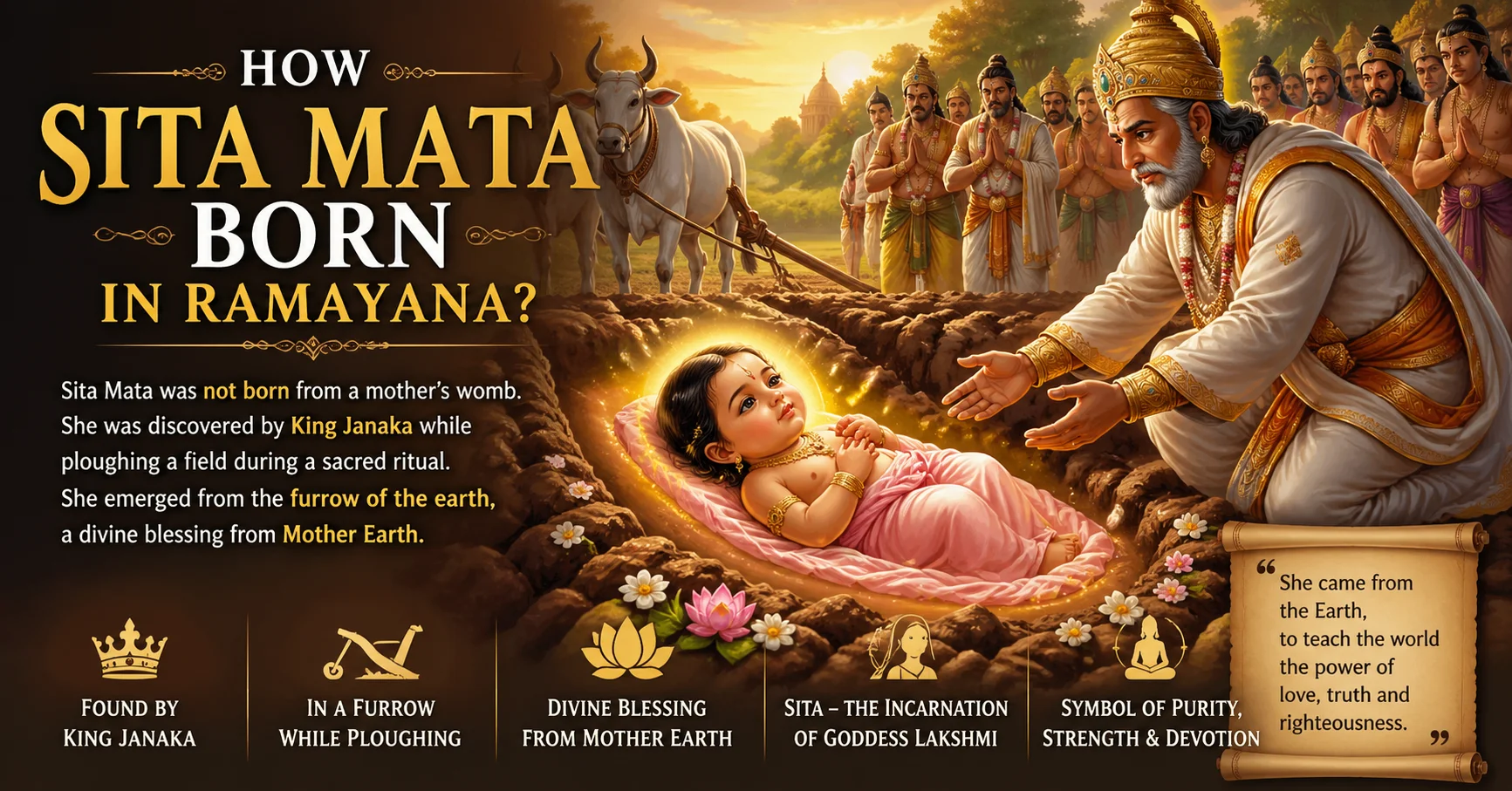
According to the Valmiki Ramayana, Sita Mata was not born from a mother’s womb. Instead, she was discovered by King Janaka, the ruler of Mithila.
One day, while ploughing a field as part of a sacred ritual (yajna), King Janaka found a baby girl emerging from the furrow of the earth. This was no ordinary event—it was a divine blessing. The king, who had no children, was overjoyed and accepted the child as his own daughter.
Because she was found in a furrow (called “Sita” in Sanskrit), she was named Sita.
Meaning Behind Her Name “Sita”
The name “Sita” literally means “furrow,” the line created when land is ploughed. This is significant because it connects her directly to Bhumi Devi, the Earth Goddess.
This is why Sita Mata is often referred to as the daughter of Mother Earth. Her birth symbolises fertility, purity, and the nurturing power of nature. It also highlights the deep connection between humans and the earth in ancient Indian philosophy.
Sita as the Incarnation of Goddess Lakshmi
In Hindu belief, Sita Mata is considered the earthly incarnation of Goddess Lakshmi, while Lord Rama is an avatar of Lord Vishnu.
Their union represents the divine partnership of Vishnu and Lakshmi, symbolising balance, harmony, and righteousness (dharma). Sita’s divine origin reinforces her role as not just a queen but also a spiritual guide and embodiment of ideal womanhood.
Different Versions of Sita Mata’s Birth
While the Valmiki Ramayana is the most widely accepted source, other texts and regional traditions offer slightly different interpretations of her birth.
1. Ramcharitmanas Version
In the Ramcharitmanas, Sita’s divine nature is emphasised, though the story of her discovery by King Janaka remains central.
2. Puranic Interpretations
Some Puranas suggest that Sita was born to fulfill a divine purpose—to assist Lord Rama in restoring dharma and defeating evil forces like Ravana.
3. Folk Traditions
In certain regional stories, Sita is believed to have appeared as a divine blessing to King Janaka after years of penance and devotion.
Despite these variations, all versions agree on one key idea: Sita Mata’s birth was not ordinary—it was divine and purposeful.
Symbolism of Sita Mata’s Birth
Sita Mata’s unique birth carries deep symbolic meanings:
1. Purity and Divinity
Being born from the earth, she represents ultimate purity and spiritual strength.
2. Connection with Nature
Her origin highlights the sacred relationship between humans and nature, especially the earth as a life-giving force.
3. Strength in Adversity
Throughout the Ramayana, Sita faces numerous challenges, yet remains steadfast and resilient—qualities rooted in her divine origin.
Role of King Janaka in Sita’s Life
King Janaka is known as a wise and spiritual ruler. He raised Sita with great love and values, ensuring she grew up with strong moral principles.
He also played a key role in her marriage by organising the famous swayamvar, where Lord Rama won her hand by lifting and breaking Lord Shiva’s bow.
Janaka’s acceptance of Sita as his daughter shows that parenthood is defined not just by birth, but by love, care, and responsibility.
Spiritual Lessons from Sita Mata’s Birth
Sita Mata’s story is not just mythology—it offers timeless lessons:
- Faith and Devotion: Trust in divine timing and purpose
- Inner Strength: Stay strong even during hardships
- Simplicity and Grace: Live with humility and dignity
- Respect for Nature: Recognise the earth as sacred
Sita Mata’s Return to the Earth
Interestingly, Sita Mata’s life comes full circle. At the end of her journey, she returns to the earth, her divine mother, reinforcing her connection with Bhumi Devi.
This moment is deeply emotional and symbolic, representing the completion of her earthly mission.
Conclusion
The birth of Sita Mata in the Ramayana is a powerful reminder of divine grace and purpose. Found in a field by King Janaka, she represents purity, strength, and devotion.
Her story continues to inspire millions, not just as the consort of Lord Rama, but as a symbol of resilience and righteousness. Understanding her origin helps us appreciate the deeper spiritual messages embedded in Indian mythology and culture.
FAQs
1. How was Sita Mata born in Ramayana?
Sita Mata was discovered by King Janaka in a furrow while ploughing a field, making her birth divine and not from a human womb.
2. Why is Sita called the daughter of Earth?
She emerged from the earth, linking her to Bhumi Devi, the Earth Goddess.
3. Is Sita an incarnation of Goddess Lakshmi?
Yes, Sita Mata is believed to be an incarnation of Goddess Lakshmi.
4. Who found Sita Mata?
King Janaka, the ruler of Mithila, found and adopted her.
5. What does Sita’s birth symbolise?
Her birth symbolises purity, divine purpose, and the sacred connection between humans and nature.
Also Read: What If Humans Could Live 150 Years?