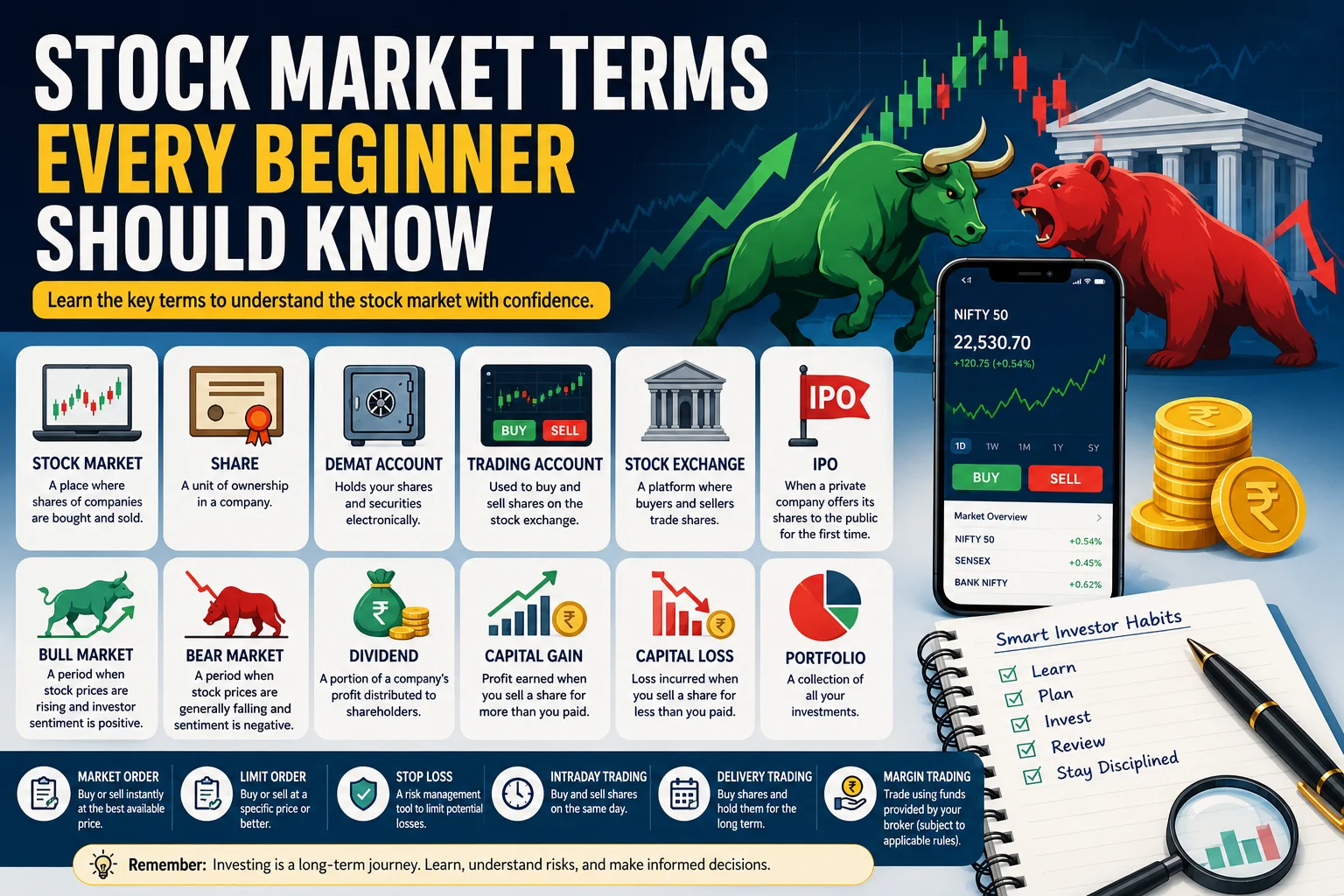
If you’re new to the stock market, you’ve probably come across terms like Demat Account, IPO, Market Order, SIP, Bull Market, Margin, and Stop Loss. At first, these words can seem confusing, making investing feel more complicated than it actually is.
The truth is, every experienced investor started as a beginner. Learning a few basic stock market terms can make it much easier to understand how the market works and help you make more informed investment decisions.
In this guide, we’ll explain the most common stock market terms in simple language with practical examples.
Why Should Beginners Learn Stock Market Terms?
Imagine trying to drive a car without knowing what the brake, clutch, or accelerator does. It would be difficult and risky.
The same applies to investing. Understanding basic stock market terminology helps you:
- Make informed investment decisions
- Understand trading platforms
- Read market news with confidence
- Reduce mistakes while investing
- Communicate effectively with brokers and financial advisors
Learning these basics doesn’t make you an expert overnight, but it provides a strong foundation for your investing journey.
1. Stock Market
The stock market is a place where investors buy and sell shares of publicly listed companies.
When you purchase shares of a company, you become a shareholder, meaning you own a small part of that business.
Example
If you buy shares of a company, you participate in its growth. If the company performs well, the value of your investment may increase. If it performs poorly, the value may decrease.
2. Share
A share represents a unit of ownership in a company.
Companies issue shares to raise money for business expansion, and investors buy these shares hoping the company’s value will grow over time.
Example
Suppose a company has 10 lakh shares.
If you own 100 shares, you own a very small percentage of that company.
3. Demat Account
A Demat (Dematerialized) Account stores your shares electronically.
Years ago, shares were issued as physical certificates. Today, all shares are stored digitally in a Demat account, making investing safer and more convenient.
Think of a Demat account as a digital locker for your investments.
4. Trading Account
A Trading Account allows you to buy and sell shares on the stock exchange.
While a Demat account stores your securities, the Trading Account is used to execute transactions.
In simple terms:
- Trading Account = Buy and sell shares
- Demat Account = Store your shares
Many beginners confuse these two accounts, but both serve different purposes.
5. Stock Exchange
A Stock Exchange is an organized marketplace where buyers and sellers trade shares.
In India, the two major stock exchanges are:
- National Stock Exchange (NSE)
- Bombay Stock Exchange (BSE)
Companies list their shares on these exchanges, allowing investors to trade them.
6. IPO (Initial Public Offering)
An IPO is the process through which a private company offers its shares to the public for the first time.
After the IPO, the company’s shares become available for trading on the stock exchange.
Example
A growing company may launch an IPO to raise money for expansion, new projects, or debt repayment.
7. Portfolio
Your portfolio is the collection of all your investments.
It may include:
- Shares
- Mutual Funds
- ETFs
- Bonds
- Gold ETFs
A diversified portfolio helps spread investment risk.
8. Bull Market
A Bull Market refers to a period when stock prices are generally rising and investor confidence is strong.
During a bull market:
- Share prices often increase.
- Investors are optimistic.
- Market sentiment is positive.
Example
If major market indices continue rising over several months and most stocks perform well, the market is generally considered bullish.
9. Bear Market
A Bear Market is the opposite of a bull market.
During a bear market:
- Share prices generally decline.
- Investors become cautious.
- Market sentiment turns negative.
Bear markets can occur due to economic slowdowns, global events, or weak corporate earnings.
10. Market Capitalization (Market Cap)
Market Capitalization, often called Market Cap, represents the total value of a company’s outstanding shares.
It is calculated using this formula:
Market Cap = Share Price × Total Outstanding Shares
Based on market capitalization, companies are commonly categorized as:
- Large Cap
- Mid Cap
- Small Cap
This classification helps investors understand the relative size of a company.
11. Dividend
A Dividend is a portion of a company’s profits distributed to its shareholders.
Not every company pays dividends. Some prefer to reinvest their profits to grow the business.
Example
If you own shares of a company that declares a dividend, you may receive a payment based on the number of shares you hold.
12. Capital Gain
A Capital Gain occurs when you sell an investment for more than you paid for it.
Example
You buy a share at ₹500.
Later, you sell it for ₹650.
Your capital gain is ₹150 per share (before taxes and transaction costs).
13. Capital Loss
A Capital Loss happens when you sell a share for less than your purchase price.
Example
You buy a share at ₹800.
Later, you sell it for ₹700.
You incur a capital loss of ₹100 per share.
Losses are a natural part of investing, which is why proper research and risk management are important.
14. Bid Price
The Bid Price is the highest price a buyer is willing to pay for a share at a given moment.
Multiple buyers may place different bids, and the highest active bid becomes the current bid price.
15. Ask Price
The Ask Price (also called the Offer Price) is the lowest price at which a seller is willing to sell a share.
When a buyer agrees to the ask price, the trade is executed.
16. Bid-Ask Spread
The Bid-Ask Spread is the difference between the bid price and the ask price.
A smaller spread often indicates that a stock has good liquidity, meaning it is easier to buy and sell.
17. Liquidity
Liquidity refers to how easily an asset can be bought or sold without significantly affecting its price.
Highly traded stocks generally have better liquidity than stocks with low trading volumes.
18. Volume
Trading Volume is the total number of shares traded during a specific period.
Higher trading volume often indicates greater investor interest in a stock.
19. Market Order
A Market Order is an instruction to buy or sell a stock immediately at the best available market price.
This is one of the simplest order types and is commonly used when your priority is to execute the trade quickly rather than waiting for a specific price.
Example
Suppose a stock is currently trading around ₹500. If you place a market order, your order will be executed at the best available price in the market at that moment, which may be slightly higher or lower depending on market movement.
20. Limit Order
A Limit Order allows you to buy or sell a stock at a price you choose.
Unlike a market order, the trade will only be executed if the stock reaches your specified price.
Example
A stock is trading at ₹750.
You believe it’s worth buying only if it falls to ₹730.
You place a limit order at ₹730. The order will execute only if the market price reaches ₹730.
21. Stop Loss
A Stop Loss is a tool that helps investors limit potential losses.
You set a price at which your shares should automatically be sold if the market moves against your expectations.
Example
You purchase a stock at ₹1,000.
To limit your risk, you place a stop-loss order at ₹950.
If the stock price falls to ₹950, your order may be triggered, helping reduce further losses.
22. Intraday Trading
Intraday Trading means buying and selling shares on the same trading day.
The goal is usually to benefit from short-term price movements. Any open intraday positions are generally squared off before the market closes, according to the broker’s policies and applicable rules.
Intraday trading requires knowledge, discipline, and proper risk management.
23. Delivery Trading
In Delivery Trading, investors buy shares with the intention of holding them beyond the trading day.
The shares are credited to the investor’s Demat account and can be held for days, months, or even years.
Many long-term investors prefer delivery trading because it focuses on long-term wealth creation rather than short-term price fluctuations.
24. Margin Trading
Margin Trading allows traders to take positions by using funds provided by the broker, subject to applicable terms and regulations.
It enables traders to increase their buying capacity, but it also increases risk because both profits and losses can be magnified.
Before using margin trading, it’s important to understand the associated risks and charges.
Helpful Tip: If you’re interested in Margin Trading Facility (MTF), the Shoonya FAQ contains platform-specific information on eligibility, charges, and operational details.
25. Volatility
Volatility refers to how much a stock’s price moves over a period of time.
- High volatility means prices change rapidly.
- Low volatility means prices are relatively stable.
While volatility creates opportunities, it also increases investment risk.
26. Blue-Chip Stocks
Blue-chip stocks are shares of well-established companies with a long history of stable performance and strong financials.
These companies are often leaders in their industries and are generally considered more stable than smaller companies, though all investments carry risk.
27. Small-Cap, Mid-Cap and Large-Cap Stocks
Companies are often grouped based on their market capitalization.
Large-Cap Stocks
Large, established companies with significant market value.
Mid-Cap Stocks
Medium-sized companies that may offer higher growth potential than large-cap companies but can also involve greater risk.
Small-Cap Stocks
Smaller companies that may have significant growth opportunities but are often more volatile.
Understanding these categories helps investors build a diversified portfolio.
28. P/E Ratio (Price-to-Earnings Ratio)
The Price-to-Earnings (P/E) Ratio compares a company’s share price with its earnings per share (EPS).
Many investors use the P/E ratio to evaluate how the market values a company’s earnings.
However, it should always be considered alongside other financial indicators rather than in isolation.
29. Earnings Per Share (EPS)
EPS measures how much profit a company earns for each outstanding share.
A higher EPS may indicate stronger profitability, but investors should also consider the company’s growth prospects, debt levels, and overall financial health.
30. Face Value
The Face Value is the original value assigned to a share when it is issued by the company.
It is different from the market price, which changes every trading day based on demand and supply.
31. Bonus Shares
Companies sometimes reward existing shareholders by issuing bonus shares.
These additional shares are allotted without requiring shareholders to pay for them, based on the company’s bonus issue ratio.
Although the number of shares increases, the overall investment value adjusts accordingly.
32. Rights Issue
A Rights Issue allows existing shareholders to purchase additional shares directly from the company, usually at a predetermined price.
Shareholders can choose whether or not to participate.
33. Circuit Limit
Stock exchanges apply circuit limits to help manage extreme price movements.
If a stock reaches its upper or lower circuit limit, trading may be restricted temporarily according to exchange regulations.
These limits are designed to promote orderly market conditions.
34. Diversification
Diversification means spreading your investments across different sectors or asset types instead of investing all your money in one company or industry.
For example, instead of investing only in banking stocks, an investor might also invest in technology, healthcare, manufacturing, and consumer goods.
Diversification can help reduce overall investment risk.
35. Risk-Reward Ratio
The Risk-Reward Ratio compares the potential profit of a trade with its possible loss.
Understanding this concept helps traders evaluate whether a trade aligns with their risk tolerance before entering a position.
Tips for Beginners Entering the Stock Market
If you’re just starting your investment journey, keep these tips in mind:
- Learn the basics before investing.
- Start with companies and products you understand.
- Avoid making decisions based on rumours or social media tips.
- Diversify your investments instead of putting all your money into one stock.
- Invest according to your financial goals and risk appetite.
- Review your investments regularly.
- Continue learning as markets evolve.
Remember, investing is a long-term journey, not a race.
Frequently Asked Questions
What is the difference between a Demat Account and a Trading Account?
A Demat Account stores your shares electronically, while a Trading Account is used to buy and sell securities on the stock exchange. Both work together but serve different purposes.
Is intraday trading suitable for beginners?
Intraday trading requires a good understanding of market movements, risk management, and trading strategies. Beginners should educate themselves thoroughly before participating and consider their financial objectives and risk tolerance.
What is a stop-loss order?
A stop-loss order is a risk management tool that helps limit potential losses by triggering an order when a stock reaches a specified price.
Why is diversification important?
Diversification reduces the impact of poor performance from a single investment by spreading investments across different sectors or asset classes.
What is an IPO?
An Initial Public Offering (IPO) is the process through which a private company offers its shares to the public for the first time before listing on a stock exchange.
Final Thoughts
The stock market may seem overwhelming when you’re just getting started, but understanding the basic terminology can make investing much easier. Terms like Demat Account, Trading Account, IPO, Market Order, Stop Loss, Margin Trading, and Diversification form the foundation of stock market knowledge.
As you continue learning, don’t try to memorize every term at once. Focus on understanding one concept at a time and gradually build your confidence. Over time, these terms will become second nature.
Before placing your first trade, it’s also a good idea to understand the platform-specific processes you’ll be using. For example, if you’re a Shoonya user and need guidance on topics such as account opening, fund transfers, Margin Trading Facility (MTF), DDPI, eDIS, IPO applications, or order-related queries, you can explore the relevant articles on the Shoonya FAQ. They provide step-by-step explanations to help you navigate common questions and procedures.
Successful investing isn’t about knowing every market term—it’s about making informed decisions, managing risk wisely, and staying committed to continuous learning. The stronger your understanding of the basics, the more confident you’ll become as an investor.
Investing for Beginners: Building an Emergency Fund and Understanding Compound Interest