If you’re planning to invest in the stock market, you’ve probably heard about Demat Accounts and Trading Accounts. Many beginners assume they’re the same, but they actually serve different purposes.
One account helps you buy and sell securities, while the other helps you store them safely in electronic form.
Understanding the difference between these two accounts is one of the first steps toward becoming a confident investor.
In this guide, we’ll explain Demat Account vs Trading Account in simple words, along with their features, benefits, and how they work together.
Why Do You Need These Accounts?
Years ago, shares were issued as physical certificates. Investors had to store paper certificates, which could be damaged, lost, or stolen.
Today, shares are held electronically, making investing much safer and more convenient.
To invest in the stock market, you’ll generally need:
- A Bank Account
- A Trading Account
- A Demat Account
Each plays a different role during the investment process.
What Is a Demat Account?
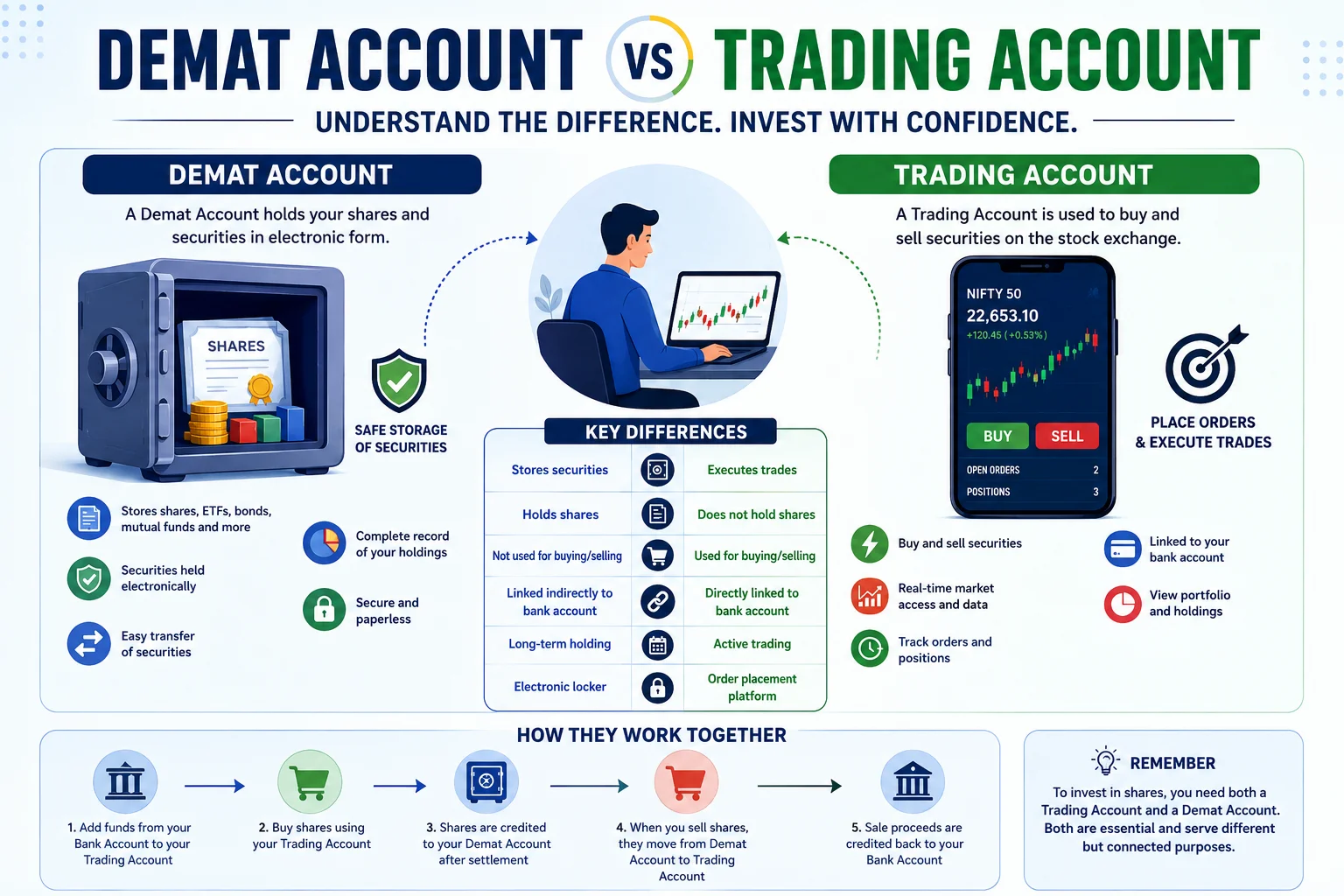
A Demat Account (Dematerialized Account) is an account that stores your shares and other securities electronically.
Think of it as a digital locker for your investments.
Instead of holding paper share certificates, your securities are safely stored in your Demat account.
You can hold various financial instruments, including:
- Equity shares
- Exchange Traded Funds (ETFs)
- Bonds
- Government Securities
- Mutual Fund units (where applicable)
- Sovereign Gold Bonds
Example
Imagine you buy 100 shares of a listed company.
Once the purchase is completed, these shares are credited to your Demat account, where they remain until you decide to sell them.
Key Features of a Demat Account
A Demat Account offers several advantages:
- Stores investments electronically
- Eliminates the risk of physical certificates
- Easy transfer of securities
- Faster settlement
- Easy portfolio management
- Safe and secure record keeping
What Is a Trading Account?
A Trading Account allows investors to buy and sell securities on stock exchanges.
It acts as a bridge between your bank account and your Demat account.
Whenever you place a buy or sell order, it is processed through your Trading Account.
Without a Trading Account, you cannot execute trades on the stock exchange.
Key Features of a Trading Account
A Trading Account enables you to:
- Buy shares
- Sell shares
- Trade ETFs
- Trade derivatives (subject to activation)
- Track open positions
- View order history
- Access market data
How Do Demat and Trading Accounts Work Together?
Many beginners wonder why they need both accounts.
Let’s understand with an example.
Step 1
You transfer money from your bank account to your Trading Account.
Step 2
Using your Trading Account, you purchase shares on the stock exchange.
Step 3
Once the trade is settled, those shares are credited to your Demat Account.
Step 4
When you decide to sell the shares later, the securities move from your Demat Account through your Trading Account and the sale proceeds are credited back to your linked bank account after settlement.
This seamless process allows investors to trade and hold securities efficiently.
Demat Account vs Trading Account
| Feature | Demat Account | Trading Account |
|---|---|---|
| Purpose | Stores securities electronically | Used to buy and sell securities |
| Holds Shares | Yes | No |
| Executes Trades | No | Yes |
| Linked to Bank Account | Indirectly | Yes |
| Used Daily for Trading | No | Yes |
| Stores Investments | Yes | No |
Do You Need Both Accounts?
In most cases, yes.
If you’re investing in equity shares in India, you’ll typically need both a Demat Account and a Trading Account.
They perform different functions but work together throughout the investment process.
Many brokers now offer both accounts as part of a single account-opening process, making it convenient for new investors.
Benefits of Having a Demat Account
Some major benefits include:
Safe Storage
No risk of losing physical share certificates.
Faster Transactions
Shares are transferred electronically.
Easy Portfolio Tracking
View all your investments in one place.
Reduced Paperwork
No physical documentation for holding securities.
Convenient Access
Access your investments anytime through supported platforms.
Benefits of Having a Trading Account
A Trading Account provides several advantages:
- Quick order placement
- Easy buying and selling
- Access to live market prices
- Order tracking
- Portfolio monitoring
- Access to multiple investment products (depending on the broker)
Can You Have Only One Account?
This is one of the most common questions among beginners.
Only Demat Account?
A Demat Account stores securities but cannot be used to buy or sell them.
Only Trading Account?
A Trading Account allows you to place orders, but purchased securities need to be held electronically in a Demat Account.
Therefore, for equity investing, both accounts generally work together.
Who Should Open a Demat Account?
A Demat Account is suitable for:
- Long-term investors
- Stock market beginners
- ETF investors
- Bond investors
- IPO applicants
- Investors building a diversified portfolio
Who Needs a Trading Account?
A Trading Account is useful for:
- Equity investors
- Intraday traders
- Delivery traders
- ETF investors
- F&O traders (after segment activation)
- Commodity and currency traders (subject to broker support and activation)
Common Mistakes Beginners Make
Avoid these common mistakes when starting your investment journey:
Assuming Both Accounts Are the Same
They serve different purposes.
Ignoring Account Charges
Understand applicable account opening, maintenance, and brokerage charges before choosing a broker.
Not Completing KYC
KYC verification is an important step in opening your account.
Forgetting to Add a Nominee
Adding a nominee helps ensure smoother account management in the future.
Investing Without Research
Always understand the risks before investing in any financial product.
How to Open a Demat and Trading Account
Although the process may vary slightly between brokers, it usually includes:
- Complete the online application.
- Submit KYC documents.
- Verify your identity.
- Link your bank account.
- Complete e-sign verification.
- Wait for account approval.
Helpful Tip: If you’re opening an account with Shoonya and need detailed guidance on documentation, KYC requirements, account activation, or onboarding, you can refer to the relevant articles in the Shoonya FAQ for step-by-step assistance.
Tips for First-Time Investors
If you’re new to investing:
- Start with companies you understand.
- Invest according to your financial goals.
- Diversify your portfolio.
- Avoid investing based on rumours.
- Learn before you trade.
- Review your investments regularly.
- Keep your account information updated.
Remember that investing is a long-term journey that requires patience and continuous learning.
Frequently Asked Questions
Is a Demat Account mandatory for investing in shares?
Yes. Shares are held electronically, so a Demat Account is generally required to hold equity investments.
Can I trade without a Trading Account?
No. A Trading Account is required to place buy and sell orders on the stock exchange.
Is a Demat Account the same as a bank account?
No. A bank account stores money, while a Demat Account stores securities such as shares, ETFs, and bonds in electronic form.
Can one Trading Account be linked to one Demat Account?
Typically, a Trading Account is linked to a Demat Account and a bank account to facilitate the buying, holding, and selling of securities.
Can I apply for an IPO using a Demat Account?
Yes. A Demat Account is required because allotted shares are credited electronically after the IPO process is completed.
Final Thoughts
Understanding the difference between a Demat Account and a Trading Account is essential for anyone entering the stock market. While a Trading Account helps you buy and sell securities, a Demat Account safely stores them in electronic form. Together, these accounts form the foundation of your investing journey.
If you’re planning to invest for the first time, take the time to understand how these accounts work, review the associated charges, and complete the necessary KYC formalities. A strong understanding of these basics will help you invest with greater confidence.
If you’re using Shoonya and have questions about account opening, KYC verification, DDPI, eDIS, fund transfers, IPO applications, or account management, you can explore the Shoonya FAQ for detailed, platform-specific guidance and step-by-step instructions.
The more you understand the basics today, the more confident you’ll be in making informed investment decisions tomorrow.
Investing for Beginners: Building an Emergency Fund and Understanding Compound Interest