If you’ve ever wanted to buy more shares than your available cash allows, you’ve probably heard about Margin Trading Facility (MTF).
MTF is a popular feature offered by many stock brokers that allows eligible investors to buy shares by paying only a part of the total value upfront, while the broker funds the remaining amount.
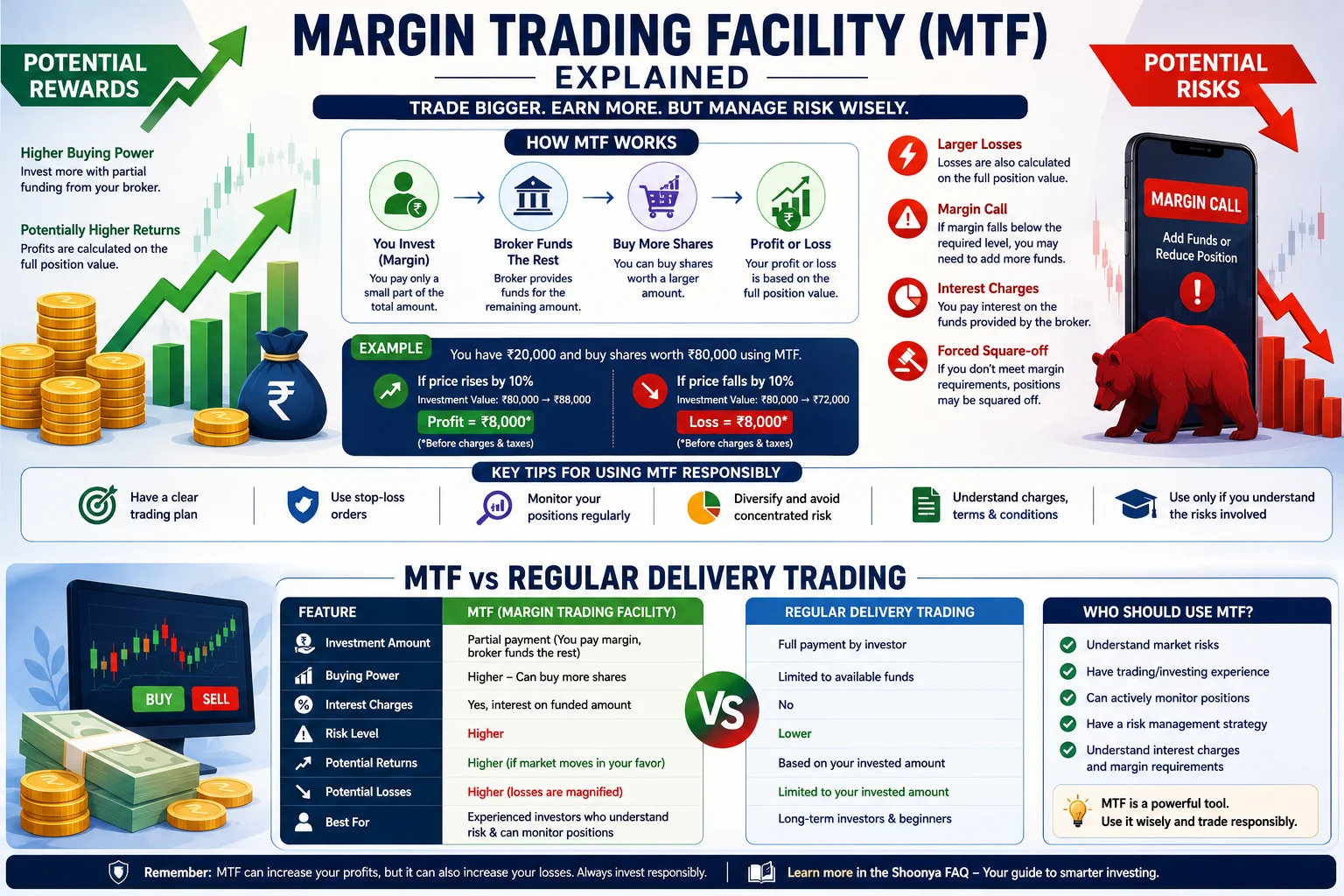
For example, if you have ₹20,000 but want to buy shares worth ₹80,000, Margin Trading Facility may allow you to do so, subject to the broker’s funding policies, margin requirements, and regulatory guidelines.
While this can increase your buying power and potentially amplify profits, it can also increase losses if the market moves against you. That’s why it’s important to understand both the opportunities and the risks before using MTF.
In this guide, we’ll explain everything you need to know about Margin Trading Facility in simple language.
What Is Margin Trading Facility (MTF)?
Margin Trading Facility (MTF) is a service that enables eligible investors to purchase shares by contributing only a portion of the total investment amount. The broker finances the remaining amount, and the purchased shares are typically held as collateral until the funded amount is repaid.
In simple terms:
You invest part of the money.
The broker provides the remaining funds.
This allows you to take a larger position than your available cash alone would permit.
Simple Example of MTF
Suppose you have:
Available cash = ₹25,000
You want to purchase shares worth ₹1,00,000.
With Margin Trading Facility (subject to applicable margin requirements), you contribute ₹25,000, while the broker funds the remaining amount.
If the share price increases, your gains are calculated on the full investment value—not just your contribution.
However, if the share price falls, your losses are also based on the full position.
This is why MTF is often described as a tool that magnifies both profits and risks.
How Does Margin Trading Facility Work?
A simplified process looks like this:
- Open and activate a Trading Account with MTF enabled (subject to eligibility).
- Deposit the required margin.
- Select eligible stocks available for MTF.
- Place your order using the Margin Trading Facility option.
- The broker funds the remaining amount.
- The shares are held as collateral while the position remains funded.
- You can repay the funded amount or sell the shares according to the broker’s policies.
What Can You Earn from Margin Trading Facility?
MTF can potentially increase returns because you’re investing with a larger amount than your own capital.
Example 1: Profit Scenario
You invest:
Your money = ₹20,000
Broker funding = ₹60,000
Total investment = ₹80,000
Suppose the stock rises by 10%.
Investment Value:
₹80,000 → ₹88,000
Profit = ₹8,000 (before brokerage, interest, taxes, and other applicable charges)
If you had invested only your ₹20,000 without MTF, a 10% increase would have resulted in a profit of ₹2,000.
This illustrates how MTF can amplify potential returns.
What Can You Lose?
This is the most important part to understand.
MTF can also amplify losses.
Example 2: Loss Scenario
Investment = ₹80,000
Stock falls by 10%.
Investment Value:
₹80,000 → ₹72,000
Loss = ₹8,000 (before applicable charges)
Without MTF, investing only ₹20,000 would have resulted in a loss of ₹2,000.
Because MTF increases your exposure, losses can also be significantly larger.
What Happens If the Market Falls Sharply?
If the value of your holdings drops below the required margin level, your broker may issue a margin call.
A margin call generally means you may need to:
- Add more funds.
- Pledge additional collateral (where applicable).
- Reduce your position.
- Allow the broker to square off positions if margin requirements are not met, subject to applicable policies.
Understanding margin calls is essential before using MTF.
Benefits of Margin Trading Facility
Increased Buying Power
You can purchase more shares than your available cash would otherwise allow.
Opportunity to Increase Returns
If the market moves in your favour, gains may be higher compared to investing only your own funds.
Flexibility
MTF allows investors to participate in opportunities without paying the full amount upfront, subject to eligibility and applicable conditions.
Better Capital Utilization
Instead of investing all your available cash in a single trade, you can allocate your funds more efficiently while using broker funding where appropriate.
Risks of Margin Trading Facility
Every investor should understand these risks before using MTF.
Larger Losses
Losses are calculated on the total position value, not just the amount you invested personally.
Interest Charges
Since the broker provides funding, interest is generally charged on the financed amount.
These charges can reduce your overall returns.
Margin Calls
If your margin falls below the required level, you may need to deposit additional funds promptly.
Forced Square-Off
If margin requirements are not met within the required timeframe, the broker may square off positions according to applicable regulations and broker policies.
Market Volatility
Sharp price movements can significantly affect leveraged positions.
Who Should Consider Using MTF?
MTF may be suitable for investors who:
- Understand market risks.
- Have experience with equity investing.
- Can actively monitor their positions.
- Have a clear risk management strategy.
- Understand the costs associated with funding.
Who Should Avoid MTF?
Margin Trading Facility may not be suitable for:
- First-time investors.
- Investors with limited knowledge of the stock market.
- Those unable to tolerate higher levels of risk.
- Investors who cannot actively monitor market movements.
- Anyone investing with money they cannot afford to lose.
Tips for Using MTF Responsibly
If you decide to use Margin Trading Facility, consider these best practices:
- Invest only after understanding the product.
- Use stop-loss orders where appropriate.
- Avoid taking larger positions than you can comfortably manage.
- Monitor your positions regularly.
- Understand the interest charges and other applicable costs.
- Diversify your investments instead of concentrating risk in one stock.
- Stay updated on market news and company developments.
MTF vs Regular Delivery Trading
| Feature | Margin Trading Facility | Regular Delivery Trading |
|---|---|---|
| Investment Amount | Partial upfront payment with broker funding | Full payment by investor |
| Buying Power | Higher | Limited to available funds |
| Interest Charges | Generally applicable on funded amount | Not applicable |
| Risk Level | Higher | Lower |
| Potential Returns | Higher (if market moves favourably) | Based on invested capital |
| Potential Losses | Higher | Limited to invested capital |
Frequently Asked Questions
Is Margin Trading Facility safe?
MTF is a regulated facility offered by brokers, but it carries higher financial risk than regular delivery trading because it involves borrowed funds.
Can beginners use MTF?
Beginners should first understand how the stock market works before using leveraged products like MTF. It’s important to be aware of the associated risks and funding costs.
Do I have to pay interest on MTF?
Generally, yes. Brokers typically charge interest on the funded amount. The applicable rate and terms vary by broker.
Can I lose more money with MTF?
Yes. Since MTF increases your market exposure, losses can also be higher compared to investing only your own capital.
What is a margin call?
A margin call is a request from your broker to maintain the required margin by adding funds or collateral when your account falls below the prescribed level.
Final Thoughts
Margin Trading Facility (MTF) can be a useful tool for investors who understand both its advantages and its risks. By allowing you to buy shares with partial funding, MTF can increase your market exposure and potentially enhance returns when investments perform well.
However, the same leverage that increases profits can also magnify losses. In addition to market risk, investors should consider interest charges, margin requirements, and the possibility of margin calls or position square-offs.
Before using MTF, make sure you understand how it works, assess your financial goals and risk tolerance, and read the terms offered by your broker. If you’re using Shoonya, you can explore the relevant Shoonya FAQ for platform-specific details on Margin Trading Facility, including activation, eligible stocks, funding terms, charges, and operational procedures.
Used responsibly and with proper risk management, MTF can be a valuable feature—but it should always be approached with caution and a clear understanding of the risks involved.
Also Read: Investing for Beginners: Building an Emergency Fund and Understanding Compound Interest