If you’re new to the stock market, Futures and Options (F&O) can seem complicated. But once you understand the basics, they’re much easier to grasp.
The key thing to remember is:
- Cash Market: You buy or sell actual shares.
- F&O Market: You trade contracts whose value is based on an underlying asset (such as a stock or an index). In many cases, traders do not intend to take delivery of the shares.
What is F&O?
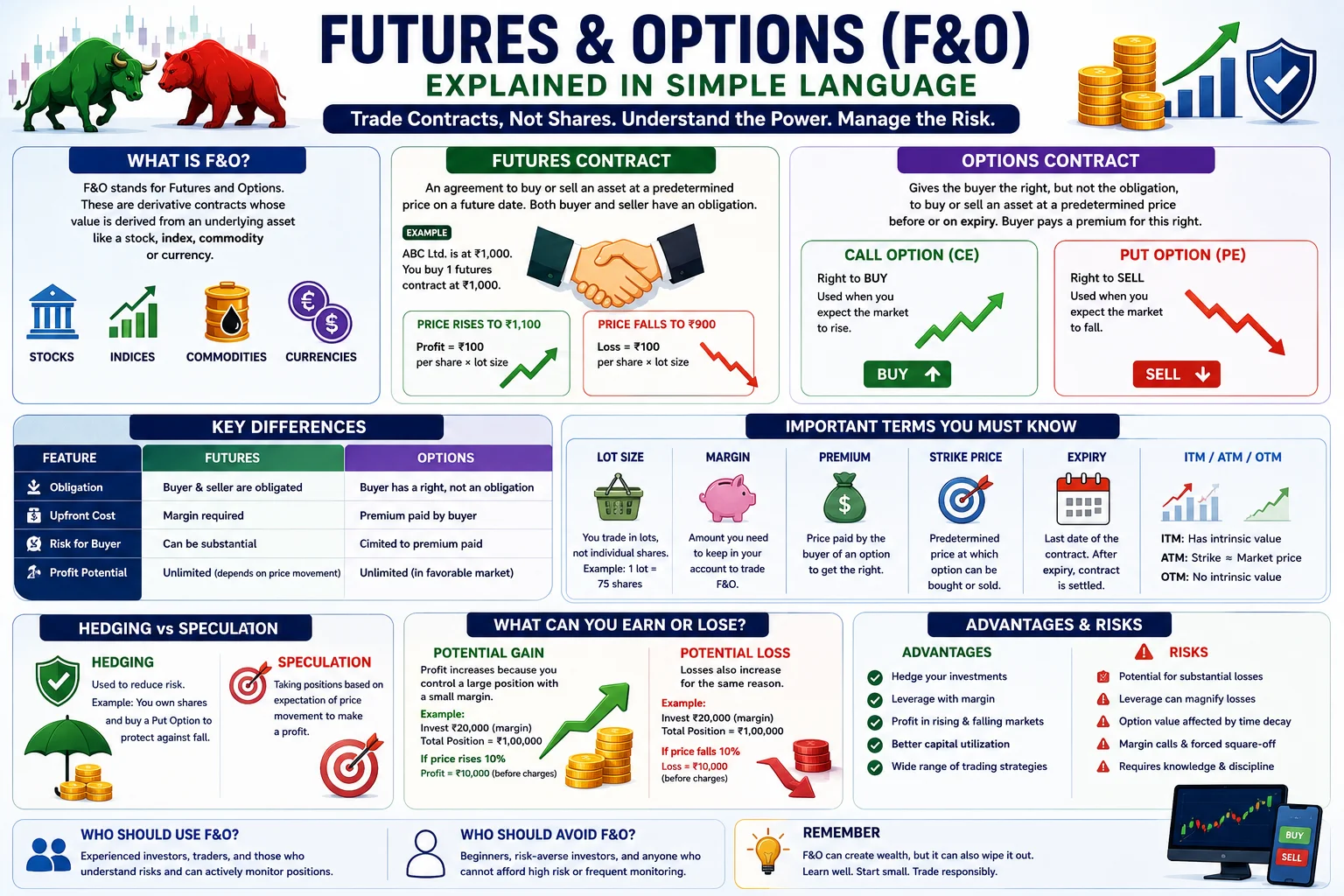
F&O stands for Futures and Options, which are types of derivative contracts.
A derivative gets its value from another asset, such as:
- A stock (e.g., Reliance, TCS)
- An index (e.g., Nifty 50, Sensex)
- Commodities
- Currencies
What is a Futures Contract?
A Futures contract is an agreement to buy or sell an asset at a predetermined price on a specified future date.
The important point is that both the buyer and the seller have an obligation under the contract.
Example
Suppose ABC Ltd. is trading at ₹1,000.
You believe the price will rise.
You buy one futures contract at ₹1,000.
Scenario 1: Price rises to ₹1,100
Profit = ₹100 per share × lot size (before brokerage, taxes, and other charges).
Scenario 2: Price falls to ₹900
Loss = ₹100 per share × lot size.
In futures, your profit or loss depends on how the market moves after you enter the contract.
Features of Futures
- Buy or sell at a future date.
- Buyer and seller are both obligated to fulfill the contract.
- Requires margin instead of paying the full contract value upfront.
- Can generate both profits and losses.
- Commonly used for hedging and speculation.
What is an Options Contract?
An Option gives the buyer the right, but not the obligation, to buy or sell an asset at a predetermined price before or on expiry.
Unlike futures, the buyer can choose whether to exercise the option.
To obtain this right, the buyer pays a premium.
Types of Options
There are two main types:
1. Call Option (CE)
A Call Option gives the buyer the right to buy an asset.
People generally buy Call Options when they expect the market to rise.
Example
Current price = ₹500
You buy a Call Option with a strike price of ₹500.
If the stock rises to ₹560, the option may increase in value.
If the stock does not rise as expected, the maximum loss for the option buyer is generally limited to the premium paid.
2. Put Option (PE)
A Put Option gives the buyer the right to sell an asset.
People generally buy Put Options when they expect the market to fall.
Example
Current price = ₹1,000
You buy a Put Option.
If the stock falls to ₹900, the option may gain value.
Difference Between Futures and Options
| Feature | Futures | Options |
|---|---|---|
| Obligation | Buyer and seller are obligated | Buyer has a right, not an obligation |
| Upfront Cost | Margin required | Premium paid by buyer |
| Risk for Buyer | Can be substantial | Generally limited to the premium paid |
| Profit Potential | Depends on price movement | Depends on option value and price movement |
| Time Decay | Not applicable in the same way | Option value is affected by time decay |
What is a Lot Size?
In F&O, you trade in lots, not individual shares.
For example, if the lot size is 75 shares, you buy or sell one contract representing 75 shares.
The exact lot size varies by stock or index and can change over time.
What is Margin?
Margin is the amount of money you need to keep in your trading account to enter and maintain an F&O position.
It is not the full value of the contract.
For example:
Contract Value = ₹10,00,000
Required Margin = ₹1,50,000 (illustrative only)
You don’t pay ₹10 lakh upfront, but your profit or loss is based on the full contract value.
What is Premium?
A premium is the price paid by the buyer of an option to acquire the rights under the option contract.
Think of it like paying a fee for the opportunity to benefit from a future price move.
What is Expiry?
Every F&O contract has an expiry date.
After expiry:
- The contract is settled according to exchange rules.
- It cannot be traded further.
What is Strike Price?
The strike price is the predetermined price at which an option buyer has the right to buy (Call) or sell (Put) the underlying asset.
Example:
Current price = ₹2,000
Strike Price = ₹2,050
This strike price defines the terms of the option contract.
In the Money (ITM), At the Money (ATM), and Out of the Money (OTM)
In the Money (ITM)
The option already has intrinsic value.
At the Money (ATM)
The strike price is approximately equal to the current market price.
Out of the Money (OTM)
The option has no intrinsic value at the current market price.
What is Hedging?
Hedging is a strategy used to reduce potential losses.
Example
Suppose you own shares of a company and are concerned the price may fall in the short term.
You might buy a Put Option to help offset some of the potential downside if the share price declines.
Hedging reduces risk, but it does not eliminate it.
What is Speculation?
Speculation means taking positions based on an expectation of future price movements, with the aim of making a profit.
Speculation can lead to gains, but it also involves the possibility of losses.
What is Open Interest (OI)?
Open Interest is the total number of outstanding F&O contracts that have not yet been closed or settled.
Traders often use OI along with price and volume to analyze market activity, but it should not be relied upon in isolation.
Why Do People Trade F&O?
Common reasons include:
- Hedging investment portfolios
- Taking positions on expected market movements
- Gaining exposure with margin instead of paying the full value upfront
- Managing risk in certain situations
Advantages of F&O
- Ability to hedge investments
- Exposure to market movements with margin
- Opportunities in both rising and falling markets
- Widely used by experienced traders for various strategies
Risks of F&O
F&O also carries significant risks:
- Potential for substantial losses
- Leverage can magnify both gains and losses
- Option buyers face time decay
- Option sellers can face significant risk depending on the strategy
- Requires knowledge, discipline, and risk management
Is F&O Suitable for Beginners?
F&O is generally more complex than investing in the cash market.
If you’re a beginner:
- Learn how the stock market works first.
- Understand concepts like margin, premium, expiry, and risk.
- Consider starting with simpler investment products before using derivatives.
- Never trade with money you cannot afford to lose.
Simple Analogy
Imagine you’re planning to buy a house.
- A Futures contract is like signing an agreement that commits both parties to complete the purchase at an agreed price in the future.
- An Option is more like paying a booking amount that gives you the choice to buy later. If you decide not to proceed, you generally lose only the booking amount (premium), while the seller keeps it.
Quick Summary
| Term | Simple Meaning |
|---|---|
| Futures | Contract with obligations for both buyer and seller |
| Options | Buyer has a right, not an obligation |
| Call Option | Used when expecting prices to rise |
| Put Option | Used when expecting prices to fall |
| Premium | Price paid to buy an option |
| Margin | Funds required to enter and maintain certain positions |
| Lot Size | Standard number of units in one F&O contract |
| Strike Price | Predetermined price in an option contract |
| Expiry | Last day the contract remains valid |
| Hedging | Reducing potential investment risk |
| Speculation | Taking positions based on expected price movements |
| Open Interest | Number of active, unsettled derivative contracts |
Investing for Beginners: Building an Emergency Fund and Understanding Compound Interest