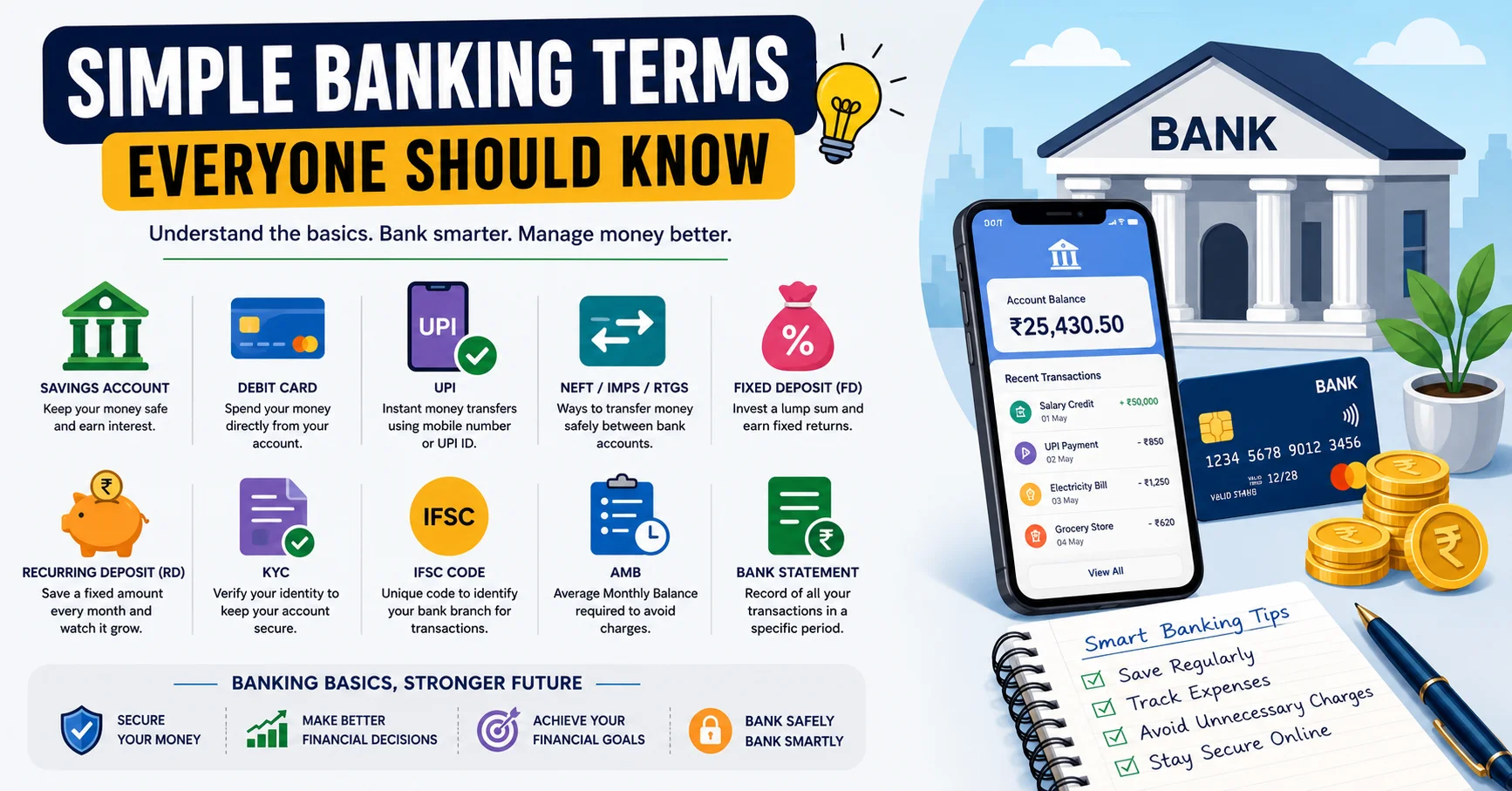
Banking has become an essential part of our daily lives. Whether you’re receiving your salary, transferring money through UPI, paying utility bills, opening a Fixed Deposit (FD), or checking your account balance, you interact with banking services more often than you may realize.
However, many people come across banking terms like IFSC, NEFT, IMPS, RTGS, AMB, KYC, FD, and UPI without fully understanding what they mean. These terms can seem confusing, especially if you’re new to banking or just starting your financial journey.
The good news is that banking doesn’t have to be complicated. Once you understand the basics, managing your money becomes much easier and more confident.
In this guide, we’ll explain some of the most common banking terms in simple, everyday language with practical examples.
Why Understanding Banking Terms Is Important
Knowing banking terminology helps you:
- Make informed financial decisions.
- Choose the right banking products.
- Avoid unnecessary charges.
- Use digital banking safely.
- Build better money management habits.
- Understand banking messages and statements.
Whether you’re a student, a working professional, or someone planning your finances, these terms will help you navigate banking with confidence.
Pro Tip: Using a personal finance app like jUMPP can help you keep track of your bank balances, spending habits, savings, and rewards in one place, making everyday money management much simpler.
1. Savings Account
A Savings Account is the most common type of bank account used to store your money securely while earning interest on your balance.
You can use it to:
- Receive your salary
- Save money
- Transfer funds
- Make UPI payments
- Pay bills
- Withdraw cash
Example
Suppose you receive your monthly salary of ₹50,000.
It gets credited to your savings account, from where you pay rent, shop online, transfer money, and save for future goals.
2. Current Account
A Current Account is mainly designed for businesses and professionals who carry out frequent financial transactions.
Unlike savings accounts, current accounts usually don’t earn interest but offer higher transaction limits.
Best for
- Business owners
- Traders
- Companies
- Freelancers with high transaction volumes
3. Fixed Deposit (FD)
A Fixed Deposit (FD) is a savings option where you deposit a lump sum amount with a bank for a fixed period and earn a guaranteed rate of interest.
The money remains invested until the maturity date unless you choose to break the FD early.
Example
You invest ₹1,00,000 in an FD for one year.
At the end of the tenure, you receive your original investment along with the interest earned.
4. Recurring Deposit (RD)
Unlike an FD, a Recurring Deposit allows you to invest a fixed amount every month instead of depositing one large amount at once.
It’s a popular option for people who want to develop a regular savings habit.
Example
Instead of investing ₹60,000 in one go, you deposit ₹5,000 every month into an RD.
5. Interest Rate
An Interest Rate is the percentage the bank pays you for keeping money in your account or the percentage you pay the bank when you borrow money.
Simple Example
Savings Account Interest = Bank pays you.
Home Loan Interest = You pay the bank.
6. Average Monthly Balance (AMB)
Average Monthly Balance (AMB) is the average balance you maintain in your savings account during a month.
Some banks require customers to maintain a minimum AMB. If the required balance isn’t maintained, the bank may charge a fee, depending on the account type.
Example
If your bank requires an AMB of ₹10,000, your average daily balance over the month should meet this requirement.
7. KYC (Know Your Customer)
KYC is the process banks use to verify your identity before opening an account or providing financial services.
Common KYC documents include:
- Aadhaar Card
- PAN Card
- Passport
- Driving Licence
- Voter ID
KYC helps prevent fraud and ensures compliance with banking regulations.
8. IFSC Code
IFSC stands for Indian Financial System Code.
It’s an 11-character code that identifies a specific bank branch in India.
You’ll often need the IFSC code when transferring money using NEFT, RTGS, or IMPS.
9. UPI (Unified Payments Interface)
UPI is one of the most widely used digital payment systems in India.
It allows users to send and receive money instantly using a mobile number, UPI ID, or QR code.
Example
You buy groceries worth ₹850.
Instead of paying cash, you simply scan the shop’s QR code and complete the payment within seconds using UPI.
10. NEFT (National Electronic Funds Transfer)
NEFT is a system used to transfer money from one bank account to another.
It’s commonly used for transferring funds securely across different banks.
While transfers are usually processed quickly, they may not always be instant.
11. IMPS (Immediate Payment Service)
IMPS enables instant bank transfers, available 24 hours a day, including weekends and holidays.
It’s ideal when money needs to reach the recipient immediately.
12. RTGS (Real-Time Gross Settlement)
RTGS is generally used for high-value transactions.
Unlike NEFT, RTGS transactions are processed individually in real time, making it suitable for transferring large amounts.
13. Debit Card
A debit card allows you to spend money directly from your bank account.
You can use it to:
- Withdraw cash from ATMs
- Shop online
- Pay at stores
- Book tickets
- Pay utility bills
The amount is deducted directly from your account balance.
14. Credit Card
A credit card allows you to borrow money from the card issuer up to a specified credit limit.
Unlike a debit card, you repay the borrowed amount later, usually through a monthly bill.
If you don’t pay the outstanding balance on time, interest charges may apply.
15. Bank Statement
A bank statement is a record of all transactions in your account during a specific period.
It typically includes:
- Salary credits
- ATM withdrawals
- UPI payments
- Bill payments
- Interest credits
- Transfers
- Account balance
Reviewing your bank statement regularly helps you track your spending and identify any unauthorized transactions.
16. Nominee
A nominee is the person authorized to receive the funds in your bank account in the event of your death.
Adding a nominee ensures a smoother claim process for your family.
17. Cheque
Although digital payments have become more common, cheques are still used for certain financial transactions.
A cheque is a written instruction directing your bank to pay a specified amount to the person or organization named on it.
18. ATM
An Automated Teller Machine (ATM) allows customers to withdraw cash, check balances, deposit cash (at selected machines), and perform other banking services without visiting a bank branch.
Tips for Safe Banking
Understanding banking terms is important, but using banking services safely is equally essential.
Follow these best practices:
- Never share your OTP or banking PIN.
- Use strong passwords for banking apps.
- Enable transaction alerts.
- Review your bank statements regularly.
- Keep your KYC information updated.
- Avoid clicking suspicious links or responding to fraudulent calls.
Using a trusted personal finance app like jUMPP can also help you monitor your spending, organize expenses, and stay informed about your financial activity alongside your regular banking.
Frequently Asked Questions
What is the difference between a Savings Account and a Current Account?
A Savings Account is designed for individuals to save money and earn interest, while a Current Account is intended for businesses with frequent transactions and generally does not offer interest.
What is the purpose of an IFSC code?
An IFSC code uniquely identifies a bank branch and is required for electronic fund transfers such as NEFT, RTGS, and IMPS.
Is UPI safe?
Yes, UPI is generally safe when used responsibly. Always verify the recipient’s details before making a payment and never share your UPI PIN or OTP with anyone.
What is AMB?
AMB (Average Monthly Balance) is the average balance maintained in your savings account during a month. Some banks require a minimum AMB to avoid maintenance charges.
Which is better: FD or RD?
An FD is suitable if you have a lump sum amount to invest, while an RD is ideal if you prefer saving a fixed amount every month.
Final Thoughts
Banking terms may seem intimidating at first, but understanding them is an important step toward becoming financially confident. Whether you’re opening your first savings account, using UPI for daily payments, investing in a Fixed Deposit, or reviewing your bank statement, knowing these basic concepts helps you make smarter financial decisions.
As banking continues to become more digital, staying informed is more important than ever. Along with understanding these terms, regularly tracking your income, expenses, and savings can improve your overall financial health.
With tools like jUMPP, you can simplify money management by keeping an eye on your spending, organizing your finances, and building better financial habits—all from one convenient app.
The more you understand your finances today, the better prepared you’ll be for tomorrow.
Also Read: Investing for Beginners: Building an Emergency Fund and Understanding Compound Interest