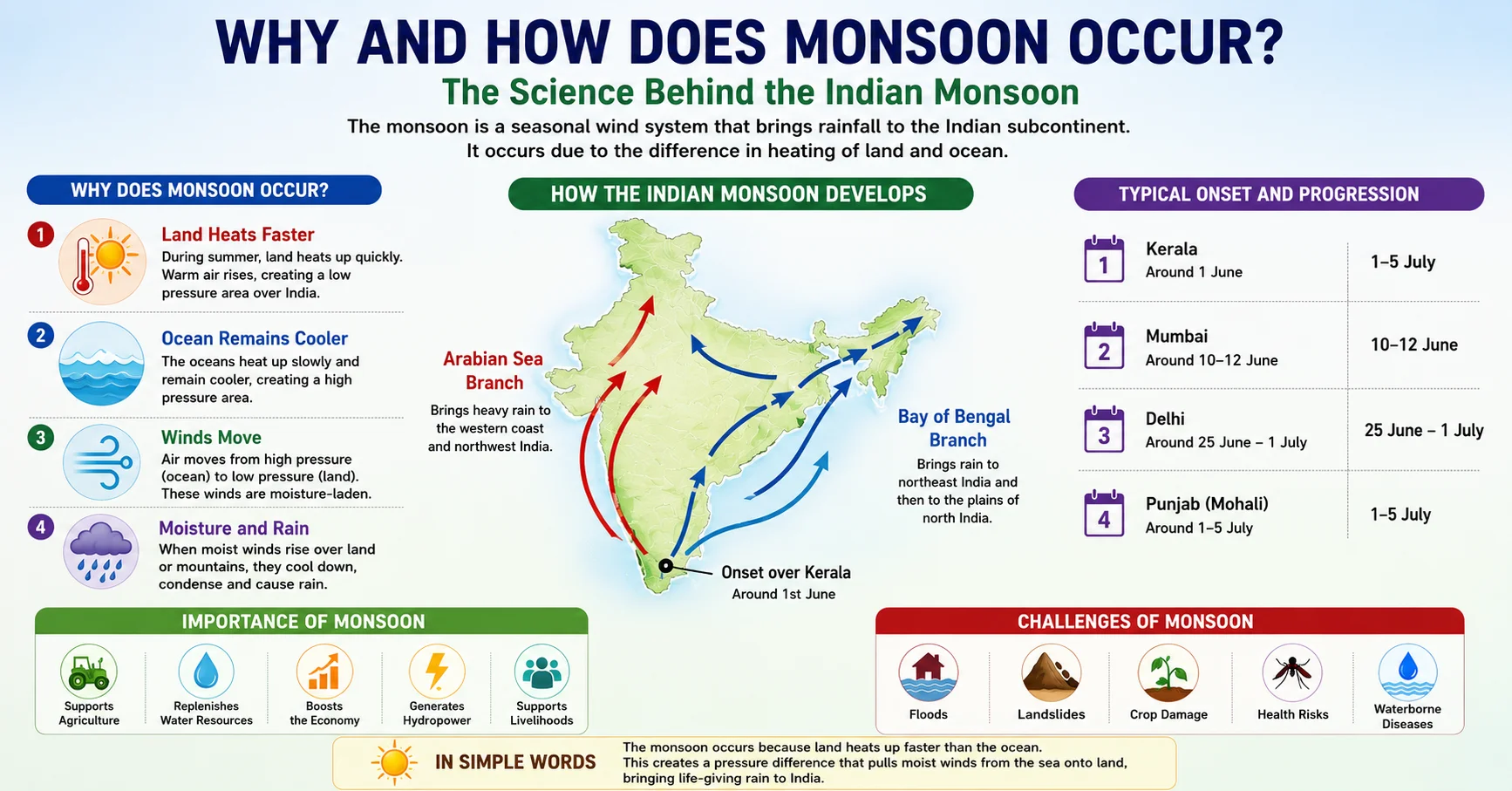
The monsoon is one of the most important weather phenomena in the world, especially in India, where it supports agriculture, water resources, and economic activities. Every year, millions of people eagerly await the arrival of the monsoon season because it brings much-needed rainfall after the scorching summer months.
But have you ever wondered why monsoons occur and how they bring rain across vast regions? Understanding the science behind monsoons helps us appreciate their significance and the role they play in sustaining life.
In this article, we will explore what a monsoon is, why it occurs, how the Indian monsoon develops, its benefits, challenges, and its impact on daily life and the economy.
What Is a Monsoon?
A monsoon is a seasonal wind system characterized by a reversal in wind direction that results in significant changes in rainfall patterns. The term “monsoon” originates from the Arabic word mausim, meaning “season.”
In simple terms, a monsoon is a weather system that brings seasonal rainfall due to differences in temperature and air pressure between land and ocean areas.
India experiences the Southwest Monsoon, which typically lasts from June to September and accounts for nearly 75% of the country’s annual rainfall.
Why Does Monsoon Occur?
The primary reason behind monsoon formation is the unequal heating of land and water.
1. Land Heats Faster Than the Ocean
During summer (April to June), the Indian landmass heats up rapidly due to intense solar radiation. Since land absorbs and releases heat faster than water, temperatures over northern and central India rise significantly.
As the land becomes hot, the air above it also heats up and rises. This creates a low-pressure area over the Indian subcontinent.
2. Oceans Remain Relatively Cooler
The surrounding oceans, including the Arabian Sea and the Indian Ocean, heat up more slowly. As a result, they maintain relatively higher air pressure compared to the land.
3. Air Moves From High Pressure to Low Pressure
Nature always tries to balance pressure differences. Therefore, air moves from high-pressure regions over the ocean toward the low-pressure regions over land.
4. Moisture-Laden Winds Reach India
The winds traveling from the ocean carry large amounts of moisture. When these moisture-rich winds reach the Indian subcontinent, they bring clouds and rainfall.
This process forms the foundation of the Indian monsoon system.
How Does the Indian Monsoon Develop?
The development of the Indian monsoon is a complex process involving atmospheric circulation, ocean temperatures, and geographical features.
Step 1: Formation of a Low-Pressure Zone
As summer intensifies, a strong low-pressure area develops over northwestern India and neighboring regions.
This low-pressure zone acts like a giant vacuum, attracting moist winds from the Indian Ocean.
Step 2: Cross-Equatorial Winds
The southeast trade winds from the Southern Hemisphere cross the equator and change direction due to the Earth’s rotation (known as the Coriolis Effect).
These winds become southwesterly winds and move toward India.
Step 3: Arrival Over Kerala
The Southwest Monsoon usually reaches the state of Kerala around June 1. This marks the official onset of the monsoon in India.
Meteorologists closely monitor this event because it signals the beginning of the rainy season.
Step 4: Two Main Branches of the Monsoon
Once the monsoon enters India, it splits into two major branches.
Arabian Sea Branch
The Arabian Sea branch moves northward along India’s western coast.
It brings heavy rainfall to:
- Kerala
- Karnataka
- Goa
- Maharashtra
- Gujarat
Mumbai receives significant rainfall because it lies directly in the path of these moisture-laden winds.
Bay of Bengal Branch
The Bay of Bengal branch travels toward northeastern India and then curves westward.
It provides rainfall to:
- West Bengal
- Assam
- Bihar
- Uttar Pradesh
- Haryana
- Punjab
Cities such as Mohali typically receive monsoon rainfall later than coastal regions because the winds must travel a longer distance inland.
Role of Mountains in Monsoon Rainfall
India’s geographical features play a crucial role in determining rainfall patterns.
Western Ghats
The Western Ghats act as a barrier to moisture-rich winds from the Arabian Sea.
When the winds strike these mountains, they are forced to rise. As they rise, they cool and condense into clouds, producing heavy rainfall.
This is why regions along the western coast receive abundant rainfall.
The Himalayas
The Himalayas prevent monsoon winds from escaping into Central Asia.
They force the winds to remain over the Indian subcontinent, resulting in widespread rainfall across northern India.
Without the Himalayas, India’s rainfall pattern would be dramatically different.
Why Does Mumbai Receive Heavy Rainfall?
Mumbai experiences intense monsoon rainfall due to several factors:
- Direct exposure to the Arabian Sea branch.
- Continuous supply of moisture from the sea.
- Proximity to the Western Ghats.
- Strong monsoon currents moving along the west coast.
As a result, Mumbai receives approximately 2,000–2,500 mm of rainfall annually, with most of it occurring between June and September.
Why Does Punjab Receive Monsoon Later?
Punjab and regions such as Mohali are located far from the coast.
Before reaching Punjab, monsoon winds must travel across large parts of India. Therefore, the monsoon usually arrives in Punjab during the first week of July.
This delay explains why coastal regions receive rain weeks before northern inland areas.
What Causes Rain During the Monsoon?
Rainfall occurs through a simple atmospheric process:
- Moist air rises into the atmosphere.
- As it rises, temperatures decrease.
- Water vapor cools and condenses into tiny droplets.
- These droplets form clouds.
- When the droplets become heavy enough, they fall as rain.
This process repeats continuously throughout the monsoon season.
Importance of the Monsoon
1. Supports Agriculture
India’s agricultural sector heavily depends on monsoon rainfall.
Major crops such as:
- Rice
- Cotton
- Sugarcane
- Pulses
- Soybeans
require adequate rainfall for healthy growth.
A good monsoon often leads to higher agricultural productivity.
2. Replenishes Water Resources
Monsoon rains refill:
- Rivers
- Lakes
- Reservoirs
- Groundwater reserves
These water sources support drinking water needs, irrigation, and industrial activities throughout the year.
3. Boosts the Economy
Agriculture contributes significantly to India’s economy. Good rainfall increases crop production, improves rural incomes, and supports related industries.
As a result, monsoon performance often influences economic growth.
4. Supports Hydropower Generation
Many hydroelectric projects depend on reservoir levels maintained by monsoon rains.
Adequate rainfall ensures reliable electricity generation.
Challenges Associated With Monsoons
While monsoons are essential, they can also create problems.
Flooding
Excessive rainfall can cause:
- Urban flooding
- River overflow
- Damage to infrastructure
- Disruption of transportation
Landslides
Mountainous regions often experience landslides during periods of intense rainfall.
Crop Damage
Both excessive and insufficient rainfall can harm crops and reduce agricultural yields.
Health Risks
Monsoon conditions may contribute to:
- Waterborne diseases
- Mosquito-borne illnesses
- Contaminated drinking water
What Is Monsoon Withdrawal?
The monsoon does not last forever. As September approaches, temperatures over land begin to decrease.
This causes:
- The low-pressure system to weaken.
- Pressure patterns to reverse.
- Winds to change direction.
- Rainfall activity to gradually reduce.
The monsoon typically withdraws from northwestern India first and then retreats southward.
By October, most parts of India transition to the post-monsoon season.
Impact of Climate Change on Monsoons
Climate change is increasingly affecting monsoon behavior.
Scientists have observed:
- More intense rainfall events.
- Longer dry spells between rain episodes.
- Unpredictable monsoon onset dates.
- Increased frequency of floods and droughts.
These changes make accurate weather forecasting more important than ever.
Conclusion
The monsoon is a remarkable natural phenomenon driven by differences in temperature and air pressure between land and ocean. During summer, the Indian subcontinent heats up rapidly, creating a low-pressure zone that attracts moisture-laden winds from the surrounding seas. These winds bring life-giving rainfall that supports agriculture, replenishes water resources, and sustains the economy.
Understanding how monsoons work helps us appreciate their importance and prepare for both their benefits and challenges. As climate patterns continue to evolve, the monsoon will remain one of the most closely monitored and influential weather systems in India.
FAQs
What is a monsoon?
A monsoon is a seasonal wind system that causes significant changes in rainfall patterns due to the reversal of wind direction.
Why does the Indian monsoon occur?
The Indian monsoon occurs because land heats up faster than the surrounding oceans, creating pressure differences that draw moisture-rich winds toward the subcontinent.
When does the monsoon usually arrive in India?
The Southwest Monsoon generally reaches Kerala around June 1 and spreads across most of India by July.
Why does Mumbai receive heavy monsoon rainfall?
Mumbai lies directly in the path of the Arabian Sea branch of the monsoon and is influenced by the Western Ghats, which enhance rainfall.
Why does Punjab receive monsoon rainfall later?
Punjab is located farther inland, so the monsoon winds take longer to reach the region compared to coastal areas.
How important is the monsoon for India?
The monsoon is vital for agriculture, water supply, hydropower generation, and overall economic growth.
How does climate change affect monsoons?
Climate change can make monsoons more unpredictable, leading to extreme rainfall events, floods, droughts, and shifting rainfall patterns.