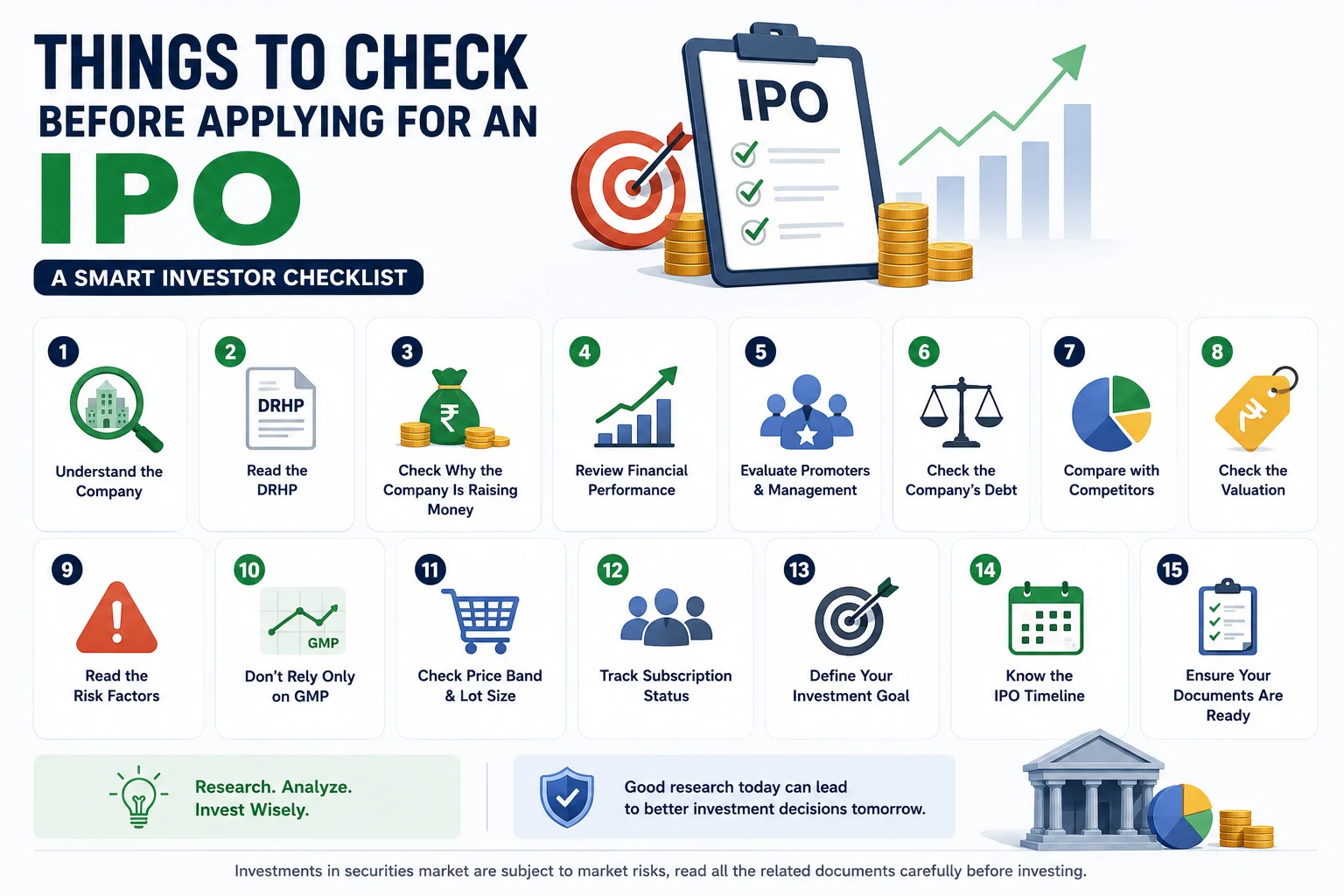
Investing in an Initial Public Offering (IPO) can be an exciting opportunity. It allows you to invest in a company before its shares start trading on the stock exchange. Many investors hope to earn listing gains or become long-term shareholders in promising businesses.
However, not every IPO turns out to be a successful investment. Some companies perform well after listing, while others may trade below their issue price. That’s why it’s important to do your research before applying for any IPO.
Whether you’re a first-time investor or someone looking to improve your IPO selection process, this guide will help you understand the key factors to consider before investing.
What Is an IPO?
An Initial Public Offering (IPO) is the process through which a private company offers its shares to the public for the first time. Once the IPO is completed, the company’s shares are listed on stock exchanges like the NSE or BSE, allowing investors to buy and sell them in the secondary market.
Companies launch IPOs for several reasons, such as:
- Raising capital for expansion
- Repaying existing debt
- Funding new projects
- Increasing brand visibility
- Meeting working capital requirements
For investors, an IPO provides an opportunity to become shareholders in the company at the time of its public listing.
Why Should You Research Before Applying?
Many people invest in IPOs simply because they hear positive news or expect quick listing gains. While market sentiment can influence demand, it should not be the only reason to invest.
A well-informed decision can help you:
- Understand the company’s business model
- Evaluate its financial health
- Identify potential risks
- Decide whether the valuation is reasonable
- Align the investment with your financial goals
Taking some time to research can help you avoid making decisions based purely on market hype.
1. Understand the Company’s Business
Before investing, ask yourself a simple question:
What does the company actually do?
You don’t need to be an expert, but you should have a basic understanding of:
- The products or services offered
- The industry it operates in
- Its target customers
- How it generates revenue
If you cannot easily understand the business model, it may be difficult to evaluate its long-term potential.
Example
If a company manufactures electric vehicle components, try to understand:
- Is the EV industry growing?
- Does the company have strong customers?
- What makes it different from competitors?
The better you understand the business, the more confident you’ll be in your investment decision.
2. Read the DRHP
One of the most valuable documents available before an IPO is the Draft Red Herring Prospectus (DRHP).
It contains detailed information about the company, including:
- Business overview
- Promoters and management
- Financial statements
- Risk factors
- Legal proceedings
- IPO objectives
- Industry overview
You don’t necessarily need to read every page, but reviewing the important sections can provide valuable insights into the company’s operations and future plans.
3. Know Why the Company Is Raising Money
Not every IPO is launched for the same reason.
Check how the company plans to use the funds raised through the IPO.
Common purposes include:
- Business expansion
- Building new manufacturing facilities
- Technology upgrades
- Research and development
- Repaying debt
- Working capital
These details are usually mentioned in the DRHP.
It’s also worth checking whether the IPO includes an Offer for Sale (OFS), where existing shareholders sell part of their stake. While an OFS isn’t necessarily a negative sign, understanding the mix between fresh issue and OFS gives you better context.
4. Check the Company’s Financial Performance
A company’s financial health is one of the most important factors to evaluate before investing.
Look for consistent growth in:
- Revenue
- Profit after tax (PAT)
- Earnings
- Operating margins
- Cash flow
Also check whether the company has managed its expenses efficiently over the years.
A business with stable financial performance is often viewed more positively than one with inconsistent results.
5. Evaluate the Promoters and Management
The people running the company play a major role in its long-term success.
Before applying for an IPO, learn about:
- Promoter background
- Management experience
- Corporate governance practices
- Past business performance
- Any major legal or regulatory issues
Experienced and credible management teams often inspire greater confidence among investors.
6. Check the Company’s Debt
Debt isn’t always bad, but excessive debt can affect a company’s financial stability.
Ask these questions:
- How much debt does the company have?
- Can it comfortably repay the debt?
- Is part of the IPO being used to reduce borrowings?
A company with manageable debt and healthy cash flows may be better positioned for future growth.
7. Compare with Competitors
Never evaluate an IPO in isolation.
Compare it with other listed companies operating in the same industry.
Look at:
- Revenue
- Profitability
- Market share
- Growth rate
- Return on Equity (ROE)
- Return on Capital Employed (ROCE)
- Valuation
This comparison helps you understand whether the IPO is reasonably priced relative to similar businesses.
8. Check the IPO Valuation
Even an excellent company may not be a good investment if its shares are priced too aggressively.
Review valuation metrics such as:
- Price-to-Earnings (P/E) Ratio
- Price-to-Book (P/B) Ratio
- Enterprise Value (EV)
- EV/EBITDA (where applicable)
Compare these ratios with industry peers to determine whether the IPO appears fairly valued.
9. Read the Risk Factors Carefully
Every IPO prospectus includes a section dedicated to risk factors.
Although many investors skip this section, it’s one of the most important parts of the document.
Some common risks include:
- Dependence on a few major customers
- High debt levels
- Regulatory challenges
- Legal disputes
- Intense competition
- Economic slowdowns
Understanding these risks helps you make a more balanced investment decision.
10. Don’t Rely Only on Grey Market Premium (GMP)
Before every IPO, you may hear people talking about the Grey Market Premium (GMP). It is the unofficial premium at which IPO shares are traded before they are listed on the stock exchange.
A high GMP often indicates positive market sentiment, but it’s important to remember:
- GMP is not regulated.
- It changes frequently.
- It does not guarantee listing gains.
- A high GMP does not necessarily mean the company is fundamentally strong.
Think of GMP as one factor among many—not the only reason to apply for an IPO.
11. Check the IPO Price Band and Lot Size
Every IPO has a price band and a lot size.
Price Band
The company specifies a minimum and maximum price at which investors can apply.
Lot Size
A lot is the minimum number of shares you can apply for.
Example
If:
- IPO Price = ₹500 per share
- Lot Size = 30 shares
Minimum investment required:
₹500 × 30 = ₹15,000
Understanding the lot size helps you plan your investment accordingly.
12. Track the IPO Subscription Status
During the IPO period, you can check how many times the issue has been subscribed.
Subscription is generally divided into categories such as:
- Retail Individual Investors (RIIs)
- Qualified Institutional Buyers (QIBs)
- Non-Institutional Investors (NIIs)
A heavily subscribed IPO often reflects strong investor interest. However, high subscription alone should not be the deciding factor. Always evaluate the company’s fundamentals before investing.
13. Decide Your Investment Goal
Before applying for any IPO, ask yourself:
Why am I investing?
Your answer may fall into one of these categories:
Listing Gains
Some investors aim to sell the shares soon after listing if the market price is favorable.
Long-Term Investment
Others invest because they believe the company has strong long-term growth potential.
Knowing your objective helps you make better investment decisions and plan your exit strategy.
14. Know the IPO Timeline
Understanding the IPO timeline helps you track your application.
The process generally includes:
- IPO opens for subscription
- IPO closes
- Basis of allotment is finalized
- Shares are credited to the Demat account (if allotted)
- Refunds or fund release (where applicable) for unsuccessful applications
- Shares are listed on the stock exchange
Keeping these dates in mind ensures you don’t miss any important updates.
15. Ensure Your Documents Are Ready
Before applying, make sure you have:
- Active Demat Account
- Trading Account
- PAN Card
- Linked Bank Account
- UPI ID (if applying through the UPI process)
- Updated KYC details
Having everything ready makes the application process smoother and helps avoid last-minute issues.
How to Apply for an IPO Using the Shoonya App
Applying for an IPO through the Shoonya App is designed to be straightforward.
The general process is:
- Log in to the Shoonya App.
- Navigate to the IPO section.
- Browse the list of available IPOs.
- Select the IPO you want to apply for.
- Enter the number of lots and your bid details.
- Review the application carefully.
- Submit the application.
- Complete the payment authorization using your UPI app, if applicable.
The exact steps may vary depending on updates to the application and the IPO process.
Helpful Tip: If you need assistance with IPO applications, account setup, UPI mandates, allotment status, or other IPO-related processes, you can visit the Shoonya FAQ for detailed, platform-specific guidance and answers to commonly asked questions.
Common Mistakes to Avoid
Many first-time investors make avoidable mistakes during the IPO process.
Here are some common ones:
Applying Without Research
Never invest simply because everyone else is applying.
Ignoring Financial Performance
A company’s financial health matters more than market excitement.
Depending Only on GMP
Grey Market Premium should never be your only decision-making factor.
Not Reading Risk Factors
Every investment carries risks. Make sure you understand them before applying.
Investing Beyond Your Budget
Only invest an amount that fits within your financial plan and risk tolerance.
Quick IPO Checklist
Before submitting your application, ask yourself:
✅ Do I understand the company’s business?
✅ Have I reviewed its financial performance?
✅ Do I know why the company is raising funds?
✅ Have I checked the valuation?
✅ Have I read the risk factors?
✅ Is my Demat Account active?
✅ Is my Trading Account active?
✅ Is my KYC complete?
✅ Do I have enough funds available?
✅ Does this investment match my financial goals?
If your answer is “Yes” to most of these questions, you’re better prepared to make an informed decision.
Frequently Asked Questions
Can beginners invest in IPOs?
Yes. Beginners can invest in IPOs, but it’s important to understand the company, its financials, and the associated risks before applying.
Is Grey Market Premium reliable?
GMP reflects unofficial market sentiment but is not regulated. It should be considered alongside other factors rather than used as the sole basis for investment decisions.
What happens if I don’t receive an IPO allotment?
If you are not allotted shares, the blocked amount is typically released according to the applicable payment process.
Can I sell IPO shares on the listing day?
Yes, once the shares are listed and credited to your Demat account, you can generally sell them during market hours, subject to exchange and broker rules.
Is a Demat Account mandatory for an IPO?
Yes. If shares are allotted, they are credited electronically to your Demat Account.
Final Thoughts
Applying for an IPO can be an exciting opportunity, but successful investing requires more than following market trends or social media discussions. Before investing, take time to understand the company’s business model, review its financial performance, assess the valuation, and carefully read the risk factors.
A well-researched investment decision is often more valuable than chasing short-term market excitement.
If you’re planning to apply through the Shoonya App, make sure your Demat Account, Trading Account, KYC, and bank details are up to date before the IPO opens. For platform-specific guidance on IPO applications, account setup, allotment, UPI mandates, or related processes, you can explore the Shoonya FAQ, which provides detailed answers and step-by-step support for common investor queries.
By combining careful research with the right tools and resources, you can approach IPO investing with greater confidence and make decisions that align with your long-term financial goals.
Also read: Investing for Beginners: Building an Emergency Fund and Understanding Compound Interest