In today’s digital world, one habit has silently become part of our morning routine — checking our phone immediately after waking up. Before brushing teeth, before drinking water, and sometimes even before opening both eyes properly, we reach for our smartphones.
But have you ever wondered why this happens?
Is it just a habit? Or is there something deeper — psychological, emotional, or even biological — behind this behavior?
In this detailed article, we will explore why we check our phone immediately after waking up, the psychological reasons behind it, its effects on mental health, and how you can break the habit if needed.
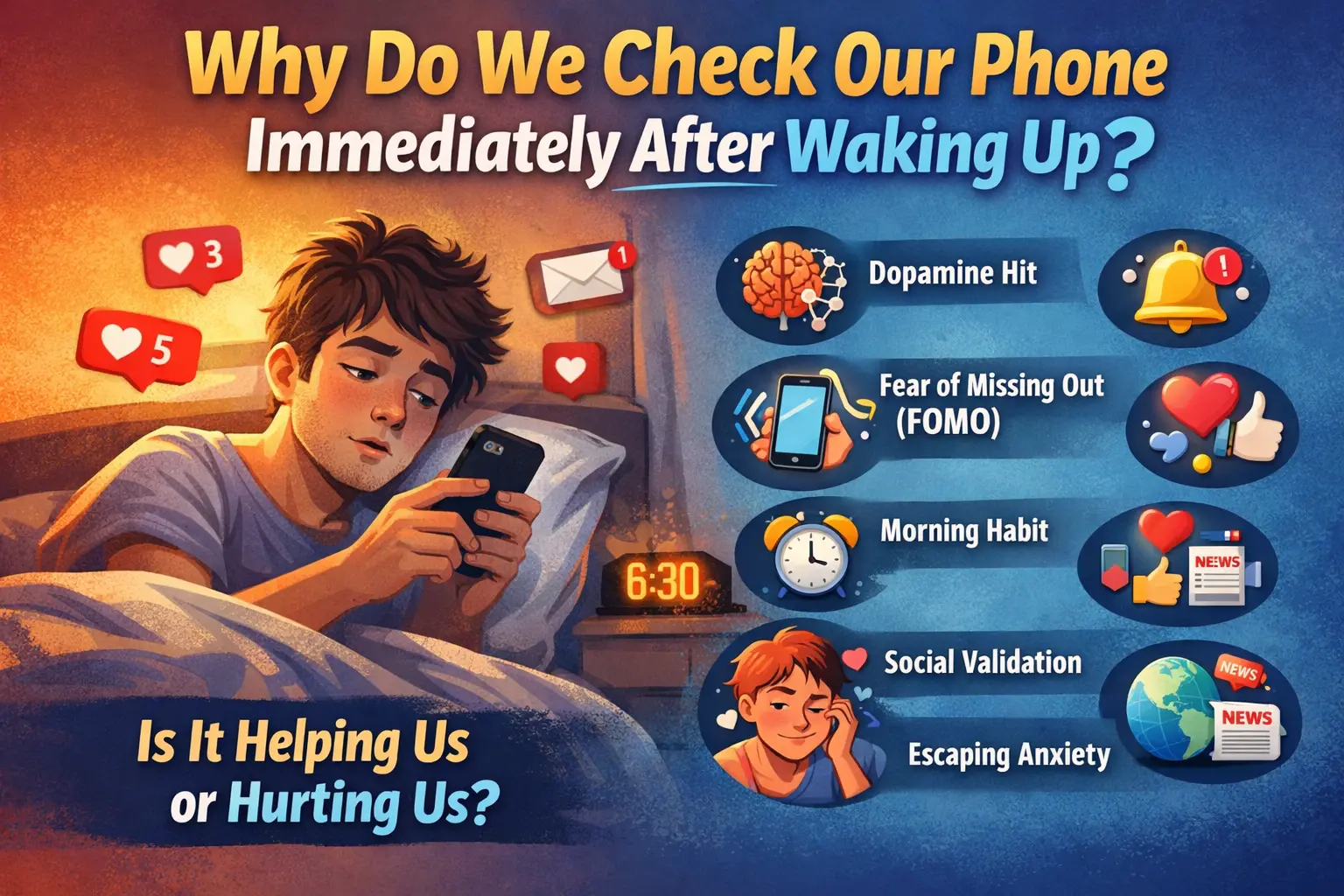
1. Dopamine: The Real Reason Behind the Habit
The biggest reason is dopamine — the “feel-good” chemical in our brain.
When you check your phone and see:
- A new message
- A social media notification
- A like or comment
- News updates
- WhatsApp replies
Your brain releases dopamine. This gives a small reward feeling.
Apps like Instagram, WhatsApp, Facebook, and YouTube are designed to trigger this reward loop.
Over time, your brain starts expecting this reward first thing in the morning.
So when you wake up, your brain says:
“Let’s check if something new happened while we were asleep.”
This becomes automatic behavior.
2. Fear of Missing Out (FOMO)
Another major reason is FOMO — Fear of Missing Out.
You might unconsciously think:
- Did someone message me?
- Did something important happen?
- Is there breaking news?
- Did someone reply to my story?
Because we are constantly connected digitally, we feel anxious about being “out of the loop.”
This fear pushes us to check our phone immediately after waking up.
3. Habit Loop: Cue → Routine → Reward
Psychologists explain habits using a loop:
- Cue – Waking up
- Routine – Picking up phone
- Reward – Notifications, updates, entertainment
After repeating this daily for months or years, it becomes automatic.
You don’t even think about it.
Your body wakes up.
Your hand moves toward the phone.
Your brain expects stimulation.
This is no longer a conscious choice — it’s conditioning.
4. Phone as an Alarm Clock
Many people use their phone as an alarm.
When the alarm rings:
- You turn it off
- You see notifications
- You check one message
- Then one more
- Then you start scrolling
Within minutes, you are deep inside apps.
The device is already in your hand, so temptation is stronger.
5. Social Validation and Self-Worth
For many people, social media engagement affects self-esteem.
You might check:
- How many likes did my post get?
- Who viewed my story?
- Did someone respond to my reel?
Platforms like Instagram and Facebook subtly connect attention with self-worth.
Morning is when curiosity is highest.
You want to “measure” your social value before starting your day.
6. Escaping Morning Anxiety
Morning can bring:
- Stress about work
- Study pressure
- Family responsibilities
- Financial worries
Instead of facing these thoughts immediately, checking your phone becomes a distraction.
Scrolling helps you:
- Avoid thinking
- Delay responsibilities
- Escape uncomfortable emotions
It gives temporary relief.
7. Information Addiction
Humans are naturally curious.
We want updates about:
- News
- Politics
- Celebrities
- Stock market
- Weather
- Sports
Apps and news platforms provide instant information.
This constant access makes our brain dependent on updates.
Checking phone in the morning feels like:
“Let me update my brain.”
8. Loneliness and Emotional Connection
Some people check their phones immediately because they feel lonely.
Seeing messages gives a feeling of connection.
Even reading group chats makes you feel socially involved.
Your brain interprets notifications as:
“You matter. Someone reached out.”
This emotional need strengthens the habit.
9. Blue Light and Brain Stimulation
Phone screens emit blue light.
Blue light:
- Stimulates alertness
- Reduces melatonin
- Signals brain to wake up
So when you check your phone, your brain shifts quickly from sleep mode to alert mode.
This makes the behavior even more reinforcing.
10. Is It Harmful?
Checking your phone immediately after waking up is not always harmful.
But it can become unhealthy if:
- You spend 30–60 minutes scrolling daily
- It affects your mood negatively
- You compare yourself to others
- You feel anxious after checking notifications
- You delay important morning tasks
Effects on Mental Health
Here are some possible effects:
1. Increased Anxiety
Reading emails or stressful messages first thing can raise stress levels instantly.
2. Reduced Productivity
Instead of starting your day calmly, your focus becomes scattered.
3. Mood Swings
Negative news or social comparison can affect your mood.
4. Poor Sleep Quality
Late-night scrolling + early morning checking reduces brain rest time.
What Happens to Your Brain in the First 30 Minutes?
The first 30 minutes after waking up are important.
Your brain is in a calm, natural state.
When you immediately:
- Check social media
- Read news
- Open work emails
You overload your brain with information.
This can:
- Increase cortisol (stress hormone)
- Reduce clarity
- Decrease mindfulness
Many productivity experts recommend avoiding phone use for at least 20–30 minutes after waking up.
How to Stop Checking Your Phone Immediately
If you want to break this habit, here are practical steps:
1. Keep Phone Away from Bed
Place it on a table away from your bed.
2. Use a Separate Alarm Clock
Avoid using your phone as an alarm.
3. Create a New Morning Routine
Replace phone time with:
- Drinking water
- Stretching
- Prayer or meditation
- Journaling
- Deep breathing
4. Turn Off Non-Essential Notifications
Reduce dopamine triggers.
5. Delay Rule
Tell yourself:
“I will check my phone after 20 minutes.”
Start small.
Benefits of Not Checking Phone Immediately
People who avoid morning scrolling often experience:
- Better focus
- Calmer mind
- Improved productivity
- Lower anxiety
- More intentional mornings
Your first thoughts shape your day.
If your first input is stress or comparison, it affects everything.
Is It Normal to Check Phone After Waking Up?
Yes. It is extremely common.
Studies show a large percentage of smartphone users check their phone within 5–10 minutes of waking up.
So you are not alone.
But awareness is important.
Ask yourself:
Is this habit serving me or controlling me?
A Healthier Alternative Morning Routine
Instead of this:
Wake up → Alarm → Notifications → Scrolling
Try this:
Wake up → Water → Deep breath → Light stretching → Gratitude → THEN phone
Even a 15-minute delay can change your mental state.
Final Thoughts
Checking your phone immediately after waking up is not just a small habit. It is influenced by:
- Dopamine reward cycles
- Fear of missing out
- Social validation
- Habit conditioning
- Anxiety avoidance
- Information addiction
Technology is not the enemy.
But unconscious usage can affect mental clarity and emotional health.
Your morning sets the tone for your entire day.
If the first thing you see is comparison, stress, or chaos, your mind starts in reactive mode.
If the first thing you experience is calm, gratitude, and intention — your day flows differently.
Small changes create big results.
Frequently Asked Questions (FAQs)
1. Why do I automatically check my phone when I wake up?
Because your brain is conditioned to expect dopamine rewards from notifications.
2. Is checking phone first thing in the morning bad?
Not always, but excessive scrolling can increase anxiety and reduce productivity.
3. How long should I avoid my phone after waking up?
Experts recommend at least 20–30 minutes.
4. Why do I feel anxious if I don’t check my phone?
That feeling is linked to FOMO and dopamine withdrawal.
5. Can this habit affect sleep?
Yes, especially if combined with late-night scrolling.