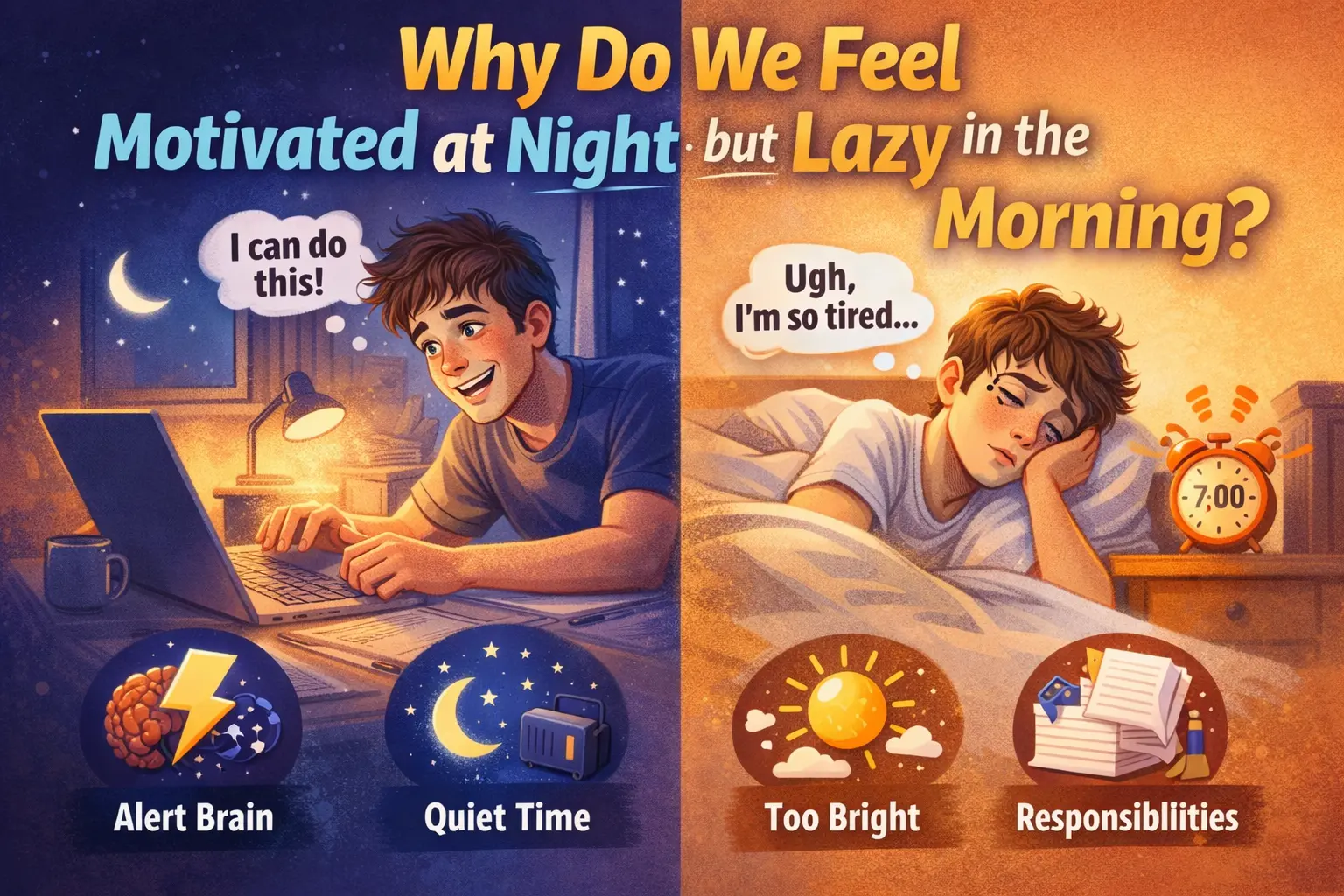
Have you ever noticed this strange pattern?
At night, you suddenly feel inspired. You want to change your life, start working out, study seriously, plan your goals, or build a new habit.
But when morning comes?
You feel tired. Lazy. Unmotivated. You hit the snooze button and delay everything you promised yourself the night before.
If this sounds familiar, you are not alone.
In this detailed, SEO-optimized article, we will explain why we feel motivated at night but lazy in the morning, the science behind it, psychological reasons, and practical ways to fix this cycle.
1. Your Brain Works Differently at Night
One of the biggest reasons behind nighttime motivation is how your brain processes pressure.
During the day:
- You face responsibilities
- You deal with work or studies
- You manage social interactions
- You handle stress
At night, most of these pressures disappear.
Your brain feels:
- Free
- Relaxed
- Less judged
- Less interrupted
This relaxed state allows creative and motivational thoughts to flow easily.
You think:
“Tomorrow I’ll wake up early.”
“I’ll start working out.”
“I’ll finish my goals.”
But motivation at night often comes without real effort — only imagination.
2. The “Tomorrow Illusion” Effect
At night, tomorrow feels far away.
Your brain treats “future you” like a different person.
Psychologically, this is called future self-optimism.
You imagine:
- Waking up fresh
- Having high energy
- Being disciplined
- Making perfect decisions
But when morning comes, reality hits.
Your body feels:
- Sleepy
- Heavy
- Low energy
So the motivation disappears.
3. Decision Fatigue Is Lower at Night
During the day, your brain makes hundreds of decisions.
By night:
- Major tasks are over
- Deadlines are done
- No urgent calls
So your brain feels mentally open.
Ironically, even though you are physically tired, your mind feels free from pressure.
This creates a false sense of productivity.
You feel motivated because you are planning, not doing.
Planning feels powerful.
Execution feels hard.
4. Night Is Quiet and Distraction-Free
At night:
- Fewer notifications
- Less noise
- Fewer interruptions
- No social pressure
This quiet environment boosts focus.
Your brain enters deeper thinking mode.
That’s why many writers, creators, and thinkers prefer working at night.
In fact, famous personalities like Franz Kafka and Nikola Tesla were known for late-night productivity.
But remember — they adjusted their lifestyle around it.
Most people don’t.
So they stay up late feeling motivated but wake up tired and lazy.
5. Your Circadian Rhythm Might Be Delayed
Your body follows a biological clock called the circadian rhythm.
Some people are:
- Morning types (early birds)
- Night types (night owls)
If you are naturally a night owl:
- Your brain becomes alert in the evening
- Creativity peaks late
- Energy rises after sunset
But society runs on morning schedules.
So you:
- Sleep late
- Wake up early
- Feel tired
- Lose morning motivation
This mismatch causes the “motivated at night, lazy in morning” cycle.
6. Dopamine and Imagination Boost at Night
At night, when you plan goals, your brain releases dopamine.
But here’s the trick:
Dopamine is released when:
- You imagine success
- You think about rewards
- You visualize achievements
You feel excited.
But in the morning, when action is required, dopamine drops.
Real effort requires:
- Discipline
- Physical energy
- Consistency
Your brain prefers dreaming over doing.
7. Morning Cortisol Spike
In the morning, your body naturally releases cortisol (stress hormone).
This hormone:
- Wakes you up
- Prepares you for challenges
- Increases alertness
But if:
- You slept late
- You didn’t sleep well
- You scrolled your phone at night
Cortisol feels like stress instead of energy.
This makes you feel:
- Overwhelmed
- Irritated
- Unmotivated
8. The Snooze Button Trap
When the alarm rings:
- You hit snooze
- You delay waking up
- Your sleep cycle breaks
This causes sleep inertia — that heavy, lazy feeling after waking up.
The more you snooze, the worse it gets.
At night, motivation is clean and clear.
In the morning, your brain is foggy.
9. Night Motivation Is Emotional, Morning Requires Logic
At night:
- Emotions are stronger
- Imagination is active
- Optimism increases
In the morning:
- Logic takes over
- Energy levels matter
- Reality sets in
Emotion-based motivation fades quickly without structure.
That’s why your powerful nighttime promises disappear by sunrise.
10. Overthinking at Night Feels Like Productivity
At night, you think deeply about:
- Life goals
- Career plans
- Fitness transformation
- Relationship improvements
This thinking gives satisfaction.
But thinking is not action.
Morning exposes the gap between thinking and doing.
That gap feels heavy — which we interpret as laziness.
11. Blue Light and Sleep Disruption
If you use your phone at night, apps like Instagram and YouTube stimulate your brain.
Blue light:
- Reduces melatonin
- Delays sleep
- Tricks brain into alert mode
So you feel awake and motivated at midnight.
But your sleep quality reduces.
Next morning:
- You feel drained
- Your focus drops
- Motivation disappears
12. Is It Laziness or Sleep Debt?
Most people are not lazy.
They are sleep-deprived.
If you:
- Sleep after 12:30 AM
- Wake before 7 AM
- Use screens before bed
Your brain doesn’t complete proper sleep cycles.
Morning tiredness is biological, not character weakness.
13. How to Fix the Cycle
If you want to stop feeling motivated only at night, try these practical solutions:
1. Write Down Night Ideas
Before sleeping, note your ideas in a notebook.
This prevents overthinking.
2. Sleep 7–8 Hours
Quality sleep fixes 60% of motivation problems.
3. Avoid Screens 30 Minutes Before Bed
Let your brain calm naturally.
4. Set One Small Morning Task
Instead of big goals, start with:
- 5 push-ups
- 10-minute reading
- Short walk
Small wins build real motivation.
5. Stop Hitting Snooze
Wake up at the first alarm.
6. Get Sunlight Within 10 Minutes
Natural light resets your biological clock.
14. When Night Productivity Is Actually Good
Some people genuinely work better at night.
If:
- Your schedule allows it
- You sleep enough
- You feel energetic consistently
Then you may simply be a night owl.
The problem is not night productivity.
The problem is inconsistent sleep patterns.
15. The Psychological Truth
Night motivation feels powerful because:
- There is no immediate pressure
- There is no required action
- Failure feels far away
- Success feels easy
Morning demands proof.
And proof requires effort.
Motivation without action is fantasy.
Morning tests discipline.
Final Thoughts
If you feel motivated at night but lazy in the morning, it doesn’t mean you lack ambition.
It usually means:
- Your sleep schedule is misaligned
- Your brain enjoys planning more than executing
- You rely on emotion instead of routine
- Your circadian rhythm favors evening
The real solution is not “more motivation.”
The solution is:
Better sleep.
Smaller goals.
Morning structure.
Consistent habits.
Motivation is temporary.
Discipline creates results.
Frequently Asked Questions (FAQs)
1. Why do I get sudden motivation at night?
Because your brain feels relaxed, creative, and free from daily pressure.
2. Why am I so lazy in the morning?
Most likely due to poor sleep, sleep inertia, or circadian rhythm mismatch.
3. Is it normal to feel more productive at night?
Yes. Some people naturally have evening chronotypes.
4. How can I transfer night motivation to morning?
Sleep earlier, set small tasks, avoid snooze, and expose yourself to sunlight.
5. Am I lazy or just tired?
In most cases, it’s tiredness — not laziness.