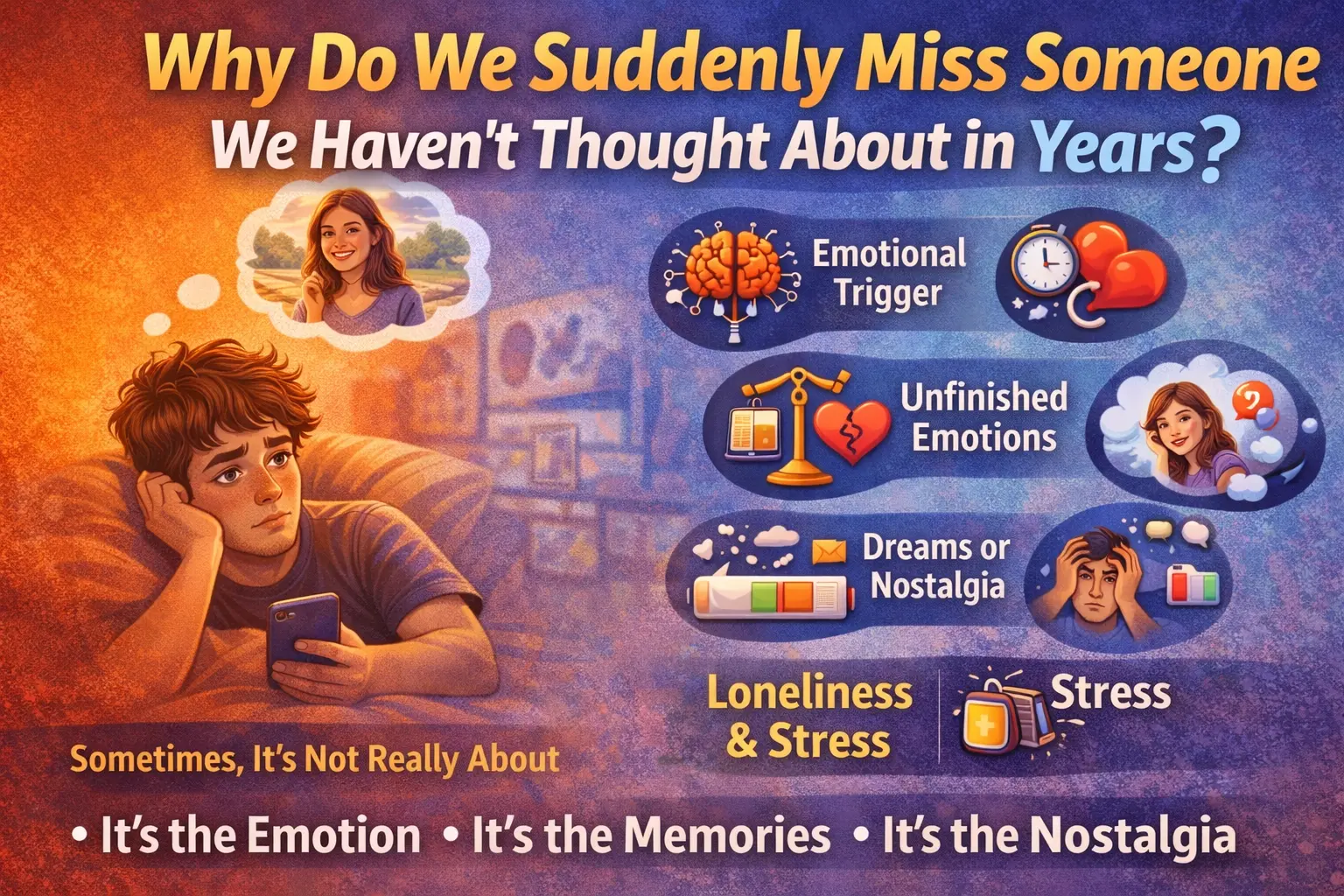
Have you ever experienced this?
You’re going about your normal day when suddenly, out of nowhere, you start missing someone you haven’t thought about in years.
It could be:
- An old friend
- A childhood crush
- An ex-partner
- A school classmate
- A relative you lost touch with
And the strange part?
There was no clear reason. No recent contact. No obvious trigger.
So why does this happen?
In this detailed, SEO-optimized article, we will explore the psychological, emotional, and scientific reasons behind suddenly missing someone after years, what it means, and whether you should act on it.
1. Memory Is Emotionally Triggered, Not Logical
Our brain does not store memories in a simple “file system.”
Memories are deeply connected to emotions.
Sometimes a small trigger can activate old emotional circuits, such as:
- A familiar smell
- A song
- A location
- A festival
- A social media post
- A dream
For example, hearing an old song by Arijit Singh might suddenly remind you of a specific person connected to that memory.
Even if you don’t consciously notice the trigger, your brain does.
That emotional connection brings the person back into your thoughts.
2. The Brain Revisits Unfinished Emotional Stories
Psychologically, humans crave closure.
If a relationship ended without proper closure:
- No final conversation
- No explanation
- No emotional resolution
Your brain keeps that memory “open.”
Years later, during calm or reflective moments, your mind may revisit it.
It’s not necessarily about the person.
It’s about unfinished emotional processing.
3. Loneliness Can Activate Old Attachments
When you feel:
- Lonely
- Emotionally vulnerable
- Stressed
- Uncertain about life
Your brain searches for familiar comfort.
Old connections feel safe because:
- They are known
- They are emotionally stored
- They remind you of simpler times
Even if that person is no longer in your life, your mind associates them with security.
4. Nostalgia Is Powerful
Nostalgia is not about missing a person.
It’s about missing a version of yourself.
You may not miss them specifically.
You may miss:
- Your school days
- College freedom
- Teenage excitement
- A time when life felt lighter
The person becomes a symbol of that phase.
So when life feels overwhelming, your mind travels back.
5. Dreams Can Reactivate Emotional Memory
Sometimes you suddenly miss someone after dreaming about them.
Dreams are created by subconscious memory mixing.
You might see:
- Their face
- A conversation
- A shared place
When you wake up, the emotional feeling lingers.
That emotional carryover makes you miss them suddenly.
6. Social Media Triggers
Platforms like Instagram and Facebook often resurface old memories.
You might see:
- “Memories from 5 years ago”
- Their profile suggestion
- A mutual friend’s update
Even without direct interaction, digital exposure reactivates stored memories.
And once activated, emotions follow.
7. Emotional Growth Brings Reflection
As we grow older, we gain emotional maturity.
Sometimes you miss someone because:
- You understand them better now
- You realize your mistakes
- You regret how things ended
Growth creates perspective.
And perspective can create longing.
8. The Brain Romanticizes the Past
Our memory is selective.
It often filters out:
- Arguments
- Conflicts
- Negative traits
And highlights:
- Good moments
- Laughter
- Support
- Warm conversations
This selective memory makes the past look better than it actually was.
So you feel like you miss something beautiful — even if reality was more complex.
9. You’re Facing Similar Situations Now
Sometimes you miss someone because your current life situation resembles your past.
For example:
- Starting a new job
- Moving to a new city
- Ending another relationship
- Feeling stuck
Your brain connects present challenges with people who were part of similar experiences before.
It’s a pattern-recognition mechanism.
10. Emotional Imprints Never Fully Disappear
Deep emotional connections create neural pathways.
Even if you haven’t thought about someone for years, those pathways remain.
When triggered, they activate instantly.
It doesn’t mean you still love them.
It means your brain stored that connection strongly.
11. You’re Missing the Feeling, Not the Person
Ask yourself:
Do I miss them?
Or do I miss how I felt with them?
Often, what we miss is:
- Feeling understood
- Feeling excited
- Feeling chosen
- Feeling carefree
The person becomes associated with those emotions.
But the real longing is for the emotional state.
12. Regret and “What If” Thoughts
Humans naturally think in “what if” scenarios.
You may wonder:
- What if we stayed friends?
- What if we handled things differently?
- What if timing was better?
These thoughts trigger temporary emotional waves.
But they don’t always reflect present reality.
13. Stress Increases Emotional Flashbacks
When stressed, the brain seeks emotional familiarity.
It might recall:
- People who once supported you
- People who made you feel calm
- Moments when life felt stable
Stress reduces logical thinking and increases emotional memory activation.
14. It Doesn’t Always Mean You Should Reach Out
Suddenly missing someone doesn’t automatically mean:
- They are thinking about you
- You are meant to reconnect
- You should text them immediately
Sometimes, it’s just emotional processing.
Acting impulsively may reopen old wounds.
Pause and reflect before making contact.
15. When Should You Reach Out?
Consider reaching out if:
- There was no toxic ending
- You genuinely want closure
- You can accept any response
- You are emotionally stable
Do not reach out if:
- You’re seeking validation
- You feel lonely
- You expect them to fix your feelings
Your intention matters.
16. Is It Love Coming Back?
Not necessarily.
Missing someone suddenly doesn’t always mean you’re still in love.
It could mean:
- You are reflective
- You are nostalgic
- You are emotionally processing
Love is consistent.
Sudden missing is usually emotional recall.
17. Psychological Explanation in Simple Terms
Your brain works like this:
Trigger → Emotional memory → Feeling → Thought → Longing
The trigger may be invisible to you.
But the emotional chain reaction is powerful.
That’s why it feels sudden.
18. What Should You Do When It Happens?
Instead of reacting immediately:
- Observe the feeling
- Ask what you’re truly missing
- Journal your thoughts
- Identify current emotional needs
- Focus on present connections
Often, the feeling fades naturally.
19. Is It Normal?
Yes, completely normal.
Almost everyone experiences sudden waves of missing someone from the past.
It’s part of being human.
Memories don’t expire.
They fade — but they can return.
Final Thoughts
If you suddenly miss someone you haven’t thought about in years, it doesn’t mean you’re weak or confused.
It usually means:
- Your brain encountered a hidden trigger
- You are emotionally reflective
- You are nostalgic
- You are processing growth
Sometimes you don’t miss the person.
You miss:
- Who you were
- How life felt
- The simplicity of that time
Memories are emotional echoes.
They remind us of our journey — not necessarily our destination.
Let the feeling pass gently.
Not every memory needs action.
Some just need understanding.
Frequently Asked Questions (FAQs)
1. Why do I randomly miss someone from years ago?
Because emotional memories can be triggered by subtle cues like songs, dreams, or stress.
2. Does it mean they are thinking about me?
No scientific evidence supports that idea. It’s usually internal emotional processing.
3. Should I text someone I suddenly miss?
Only if your intention is healthy and you can accept any outcome.
4. Why does it feel so intense suddenly?
Because emotional memories activate quickly and strongly when triggered.
5. Is it love or just nostalgia?
Often it’s nostalgia — missing the feeling, not the person.