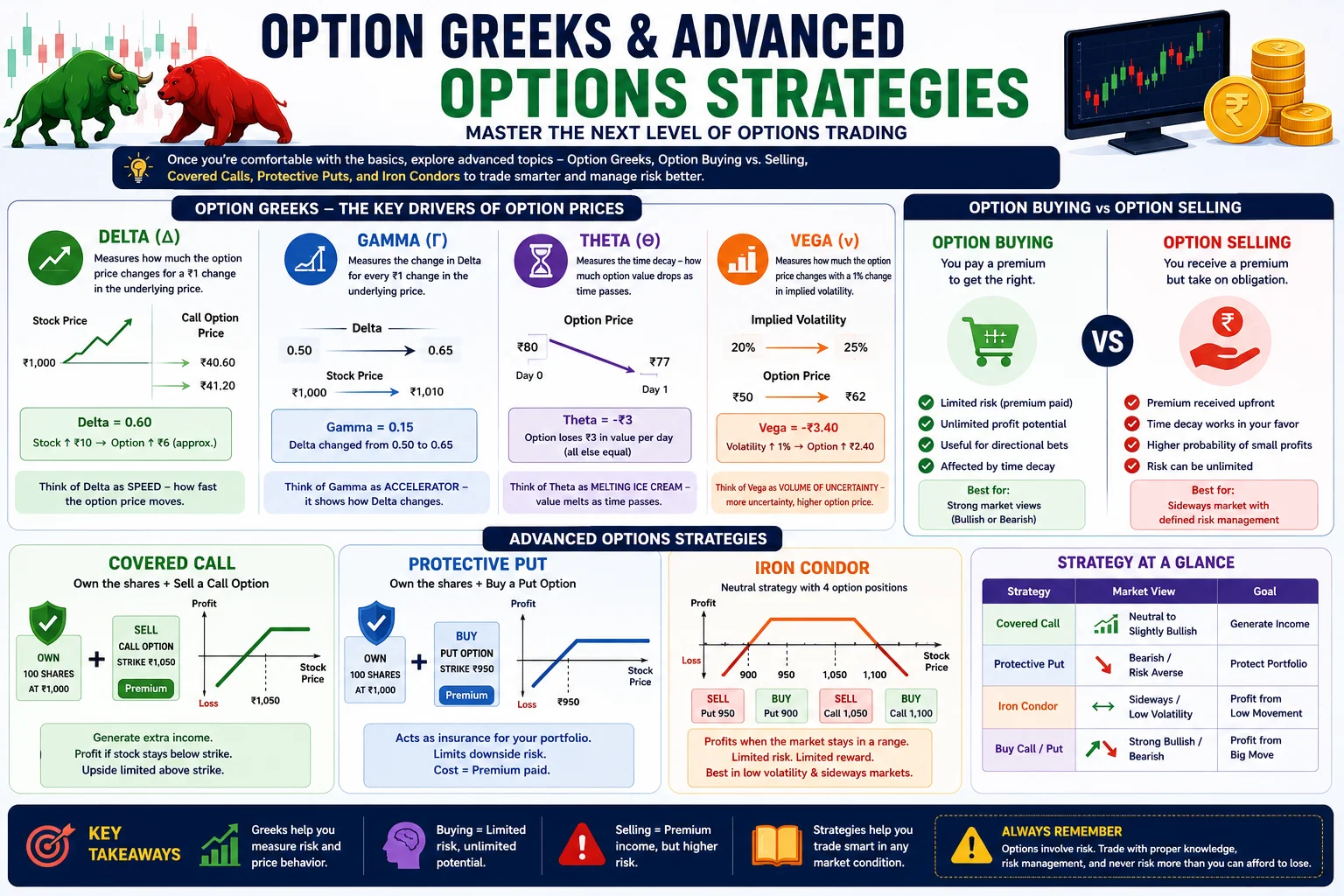
Once you’ve understood the basics of Futures & Options (F&O), the next step is learning advanced options concepts. These help experienced traders analyze risk, understand option pricing, and build strategies for different market conditions.
Let’s go through each concept in simple language.
1. Option Greeks
Option Greeks are measurements that help traders understand how an option’s price may change when market conditions change.
Think of them as indicators that answer questions like:
- What happens if the stock price moves?
- What happens if time passes?
- What happens if market volatility increases?
The four main Greeks are:
- Delta (Δ)
- Gamma (Γ)
- Theta (Θ)
- Vega (ν)
Delta (Δ)
What is Delta?
Delta tells you how much the price of an option may change if the underlying stock price changes by ₹1.
It also gives a rough idea of how sensitive the option is to movements in the underlying asset.
Example
Suppose:
- Stock Price = ₹1,000
- Call Option Premium = ₹40
- Delta = 0.60
If the stock price increases by ₹1:
The option premium may increase by approximately ₹0.60.
If the stock rises by ₹10:
The option premium may increase by about ₹6 (before considering other factors).
Easy Way to Remember
Delta = Speedometer
It shows how fast the option price reacts when the stock price moves.
Gamma (Γ)
What is Gamma?
Gamma measures how much Delta itself changes when the stock price changes.
Example
Current Delta = 0.50
Stock rises.
New Delta = 0.65
Gamma measures this change in Delta.
Easy Example
Imagine driving a car.
- Delta = Speed
- Gamma = Acceleration
Theta (Θ)
What is Theta?
Theta measures how much value an option loses as time passes, assuming other factors remain the same.
This is often called time decay.
Every day that passes brings the option closer to expiry, and this can reduce its value.
Example
Premium = ₹80
Theta = -₹3
Tomorrow:
Premium ≈ ₹77 (all else being equal)
Important
Option buyers are generally affected negatively by time decay.
Option sellers may benefit from time decay if other market factors remain unchanged.
Easy Way to Remember
Theta = Melting Ice Cream
The longer you wait, the more it melts.
Vega (ν)
What is Vega?
Vega measures how much an option’s price changes when market volatility changes.
Example
A major company is about to announce earnings.
Expected volatility increases.
Option premiums often increase because larger price movements become more likely.
Easy Way to Remember
Higher uncertainty → Higher option premiums (all else being equal).
Summary of Greeks
| Greek | Measures |
|---|---|
| Delta | Price sensitivity to the underlying asset |
| Gamma | Change in Delta |
| Theta | Time decay |
| Vega | Sensitivity to changes in implied volatility |
2. Option Buying
Option buying means purchasing a Call or Put Option.
You pay a premium to obtain the rights associated with the option.
Example
Premium = ₹80
Lot Size = 75
Investment = ₹6,000
If the market moves in your favor, the option may increase in value.
If it doesn’t, the buyer’s maximum loss is generally limited to the premium paid.
Advantages of Option Buying
✔ Limited risk (premium paid)
✔ Potential for significant returns if the market moves favorably
✔ Suitable for directional market views
Disadvantages
- Time decay can reduce option value.
- The market needs to move sufficiently before expiry to offset the premium paid.
3. Option Selling (Writing)
Option selling means you receive a premium upfront in exchange for taking on obligations under the option contract.
Example
You sell an option.
Premium received = ₹100
If the option expires without being exercised, you may retain the premium (subject to market conditions and settlement rules).
However
If the market moves significantly against your position, losses can be substantial depending on the strategy used.
Advantages
- Receive premium upfront.
- Time decay generally works in favor of the seller.
Risks
Potential losses can be much larger than the premium received, depending on the position and market movement.
Option Buying vs Option Selling
| Feature | Option Buying | Option Selling |
|---|---|---|
| Pay Premium | Yes | No (premium is received) |
| Risk | Generally limited to premium paid | Can be significant depending on strategy |
| Reward | Potentially substantial | Usually limited to premium received |
| Time Decay | Works against buyer | Often benefits seller |
4. Covered Call
A Covered Call involves:
✔ Owning shares
✔ Selling a Call Option on those shares
This strategy is commonly used to generate additional income from shares you already own.
Example
You own 100 shares of a company.
You sell a Call Option on those shares.
If the stock stays below the strike price until expiry, you may keep both the shares and the premium received.
However, if the stock rises above the strike price, your upside may be limited because you may have to sell the shares at the agreed strike price.
Best Used When
You expect the stock price to remain relatively stable or rise only moderately.
5. Protective Put
A Protective Put is often compared to insurance for your investment.
Example
You own shares worth ₹2,00,000.
You’re worried the market may decline.
You buy a Put Option.
If the stock price falls sharply, gains from the Put Option may help offset some of the losses on your shares.
Think of It Like Insurance
Just as you pay an insurance premium to protect your car, you pay an option premium to help protect your investment.
6. Iron Condor
The Iron Condor is an advanced options strategy that combines four option positions.
Its objective is generally to benefit when the underlying asset stays within a specific price range until expiry.
Simple Idea
You expect:
The market will not move much.
Instead of predicting whether it will go up or down, you’re expecting it to remain within a defined range.
If that happens, the strategy may generate a profit.
Because it involves multiple option positions, the Iron Condor is typically used by experienced traders who understand option pricing and risk management.
Which Strategy Fits Which Market?
| Market View | Common Strategy |
|---|---|
| Strong Bullish | Buy Call |
| Strong Bearish | Buy Put |
| Sideways Market | Iron Condor |
| Own Shares & Want Extra Income | Covered Call |
| Own Shares & Want Protection | Protective Put |
Final Advice for Beginners
Advanced options strategies can be powerful, but they also require a deeper understanding of how options behave.
Before using them:
- Learn the basics thoroughly.
- Understand how option Greeks influence pricing.
- Practice with paper trading or simulated environments if available.
- Always define your maximum acceptable loss before entering a trade.
- Remember that no strategy guarantees profits.
Building knowledge gradually is often more effective than trying to master every strategy at once. A solid understanding of the fundamentals will make advanced concepts much easier to apply responsibly.
Experience seamless trading with the Shoonya App.