Pursuing an MBBS degree in the Philippines has become a popular choice for Indian students due to affordable fees, English-medium education, and US-based curriculum structure. However, after completing their medical degree, students must clear the Foreign Medical Graduate Examination (FMGE) to practice medicine in India.
While many students choose the Philippines for medical education, clearing FMGE often turns out to be a major hurdle. In this article, we’ll explore the key challenges faced by Philippines-returned students and how to overcome them effectively.
Why FMGE is Challenging for Philippines Students
The FMGE is known for its low pass percentage, often ranging between 10% to 25%. Students from the Philippines face additional difficulties due to differences in curriculum, exam pattern, and clinical exposure.
Let’s break down the major challenges.
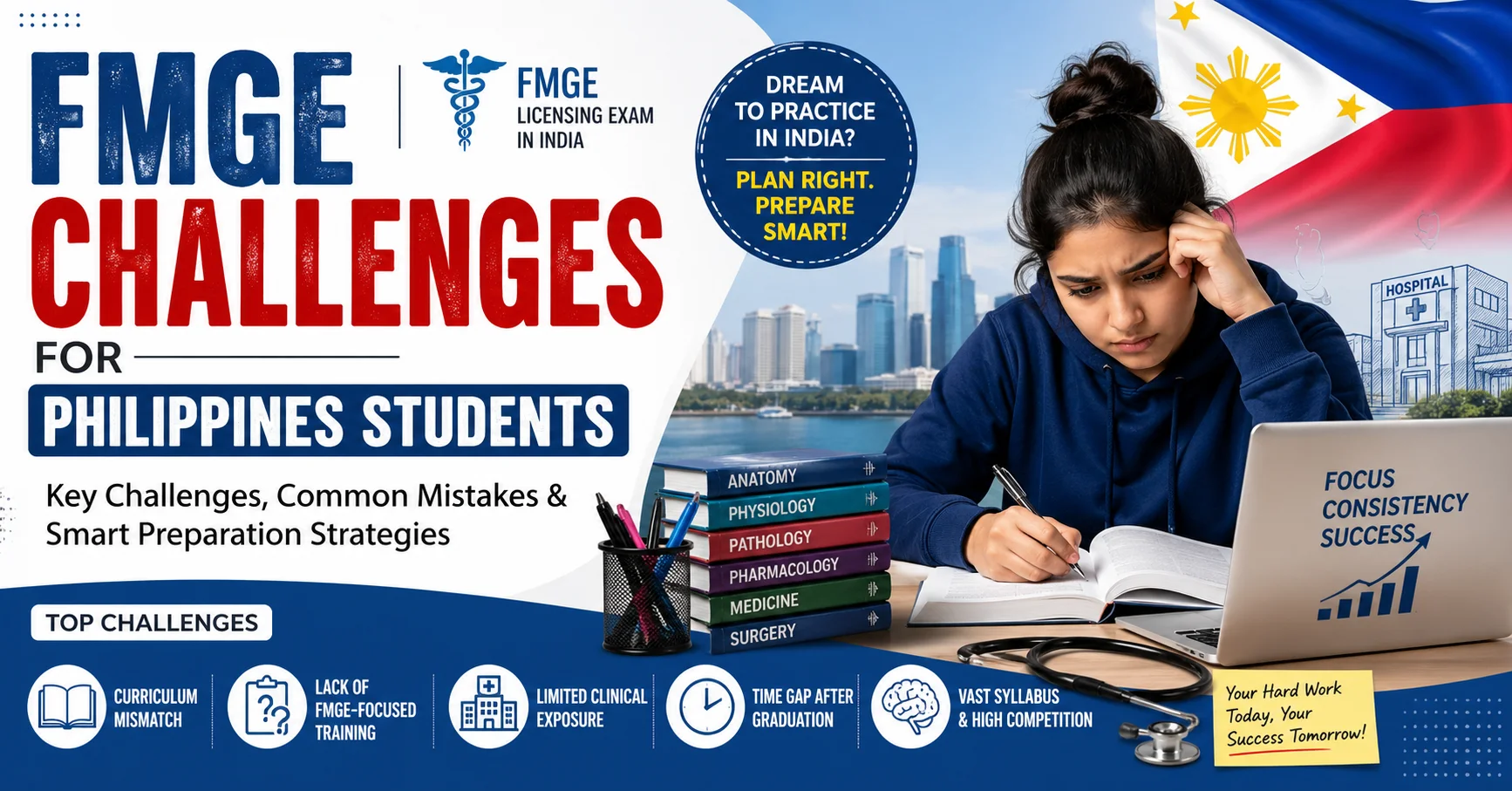
1. Curriculum Mismatch with Indian Standards
One of the biggest challenges is the difference between the Philippine medical curriculum and Indian medical education.
- The Philippines follows a US-based system
- More focus on conceptual understanding rather than exam-oriented study
- Less emphasis on subjects like PSM and Indian healthcare system
In contrast, FMGE is heavily aligned with the Indian MBBS syllabus. This creates a gap that students must bridge during preparation.
2. Lack of FMGE-Oriented Preparation During MBBS
Most universities in the Philippines do not train students specifically for FMGE.
- No focus on previous year questions
- Limited exposure to MCQ-based exams
- Lack of structured revision
As a result, students often start FMGE preparation from scratch after completing their degree, which can be overwhelming.
3. Clinical Exposure Differences
Although students in the Philippines receive clinical training, the exposure can differ from Indian hospitals.
- Fewer patient loads in some hospitals
- Limited hands-on practice
- Differences in disease patterns
FMGE tests practical knowledge through clinical-based MCQs, making this gap a significant challenge.
4. Time Gap After Graduation
Many students return to India after completing their course and then begin FMGE preparation.
This leads to:
- Loss of study momentum
- Forgetting core concepts
- Difficulty in restarting preparation
Managing this gap effectively is crucial for success.
5. Vast Syllabus and Subject Coverage
FMGE covers all 19 subjects of MBBS, including:
- Anatomy
- Physiology
- Pathology
- Pharmacology
- Medicine
- Surgery
For Philippines students, revising all subjects again in a limited time becomes a major challenge.
6. Concept vs. MCQ-Based Exam Approach
Philippine education focuses more on understanding concepts, while FMGE is a highly MCQ-based exam.
Students struggle with:
- Time management during exams
- MCQ-solving techniques
- Negative marking mindset (even though FMGE has no negative marking, accuracy matters)
Adapting to this format requires dedicated practice.
7. Language is Not the Problem—but Application Is
Since the medium of instruction in the Philippines is English, language is usually not a barrier.
However, the challenge lies in:
- Applying theoretical knowledge to MCQs
- Interpreting tricky questions
- Handling integrated questions across subjects
8. Low Pass Rate Pressure
The low pass percentage of FMGE creates psychological pressure among students.
- Fear of failure
- Anxiety and stress
- Lack of confidence
This mental pressure can affect performance if not managed properly.
How Philippines Students Can Overcome FMGE Challenges
Despite these challenges, thousands of students clear FMGE every year. With the right strategy, success is absolutely achievable.
1. Start Early Preparation
Don’t wait until graduation. Begin FMGE preparation during your MBBS itself.
- Focus on Indian standard textbooks
- Solve MCQs regularly
- Build strong basics
2. Use FMGE-Focused Study Materials
Choose resources that are specifically designed for FMGE preparation.
- Previous year question banks
- MCQ practice platforms
- Revision notes
3. Practice MCQs Daily
MCQ practice is the key to cracking FMGE.
- Solve at least 100–150 MCQs daily
- Analyze mistakes
- Revise weak topics
4. Focus on High-Yield Topics
Not all topics are equally important. Focus more on:
- Pathology
- Pharmacology
- Medicine
- PSM
These subjects carry higher weightage in FMGE.
5. Take Mock Tests Regularly
Mock tests help you:
- Improve time management
- Understand exam pattern
- Build confidence
Make sure to simulate real exam conditions.
6. Strengthen Clinical Concepts
Even if exposure was limited, you can improve clinical understanding by:
- Studying case-based questions
- Watching clinical videos
- Revising practical scenarios
7. Maintain Consistency and Discipline
Consistency is more important than studying for long hours.
- Study daily
- Revise regularly
- Avoid long breaks
8. Manage Stress and Stay Positive
Mental health plays a crucial role in exam success.
- Take short breaks
- Stay physically active
- Avoid comparison with others
Confidence and mindset can make a huge difference.
Is Studying in the Philippines Still Worth It?
Despite FMGE challenges, many students successfully clear the exam and build successful medical careers in India.
The key lies in:
- Early awareness of FMGE requirements
- Smart preparation strategies
- Consistent effort
If planned well, studying in the Philippines can still be a good option.
Conclusion
Clearing the Foreign Medical Graduate Examination (FMGE) is undoubtedly challenging for students who complete their MBBS in the Philippines. Differences in curriculum, lack of exam-focused preparation, and the vast syllabus make it difficult—but not impossible.
With the right mindset, proper strategy, and consistent practice, Philippines students can overcome these challenges and achieve success.
FAQs
1. Why is FMGE difficult for Philippines students?
FMGE is difficult due to curriculum differences, lack of MCQ practice, and limited exposure to Indian exam patterns.
2. What is the FMGE pass percentage?
The pass percentage usually ranges between 10% to 25%, making it a competitive exam.
3. Can Philippines students clear FMGE in the first attempt?
Yes, with proper preparation, many students clear FMGE on their first attempt.
4. How should I prepare for FMGE after studying in the Philippines?
Focus on MCQs, revision, mock tests, and high-yield topics aligned with the Indian syllabus.
5. Is clinical exposure in the Philippines enough for FMGE?
While helpful, students may need additional preparation for clinical-based MCQs.