If you have checked gold prices recently, the number probably stopped you for a moment.
Gold in India is currently trading at approximately ₹15,295 per gram for 24 karat gold — a level that would have seemed extraordinary just a few years ago. On 25 April 2026, domestic and international gold prices are showing mild upward momentum, reflecting cautious investor sentiment, while in India demand remains steady due to cultural buying patterns and investment diversification.
This is not a temporary blip or market noise. The gold price surge of 2026 is driven by a powerful combination of global and domestic forces that are structural, interconnected, and unlikely to reverse quickly. Here is a clear, factual explanation of exactly why gold rates are increasing right now — and what it means for you.
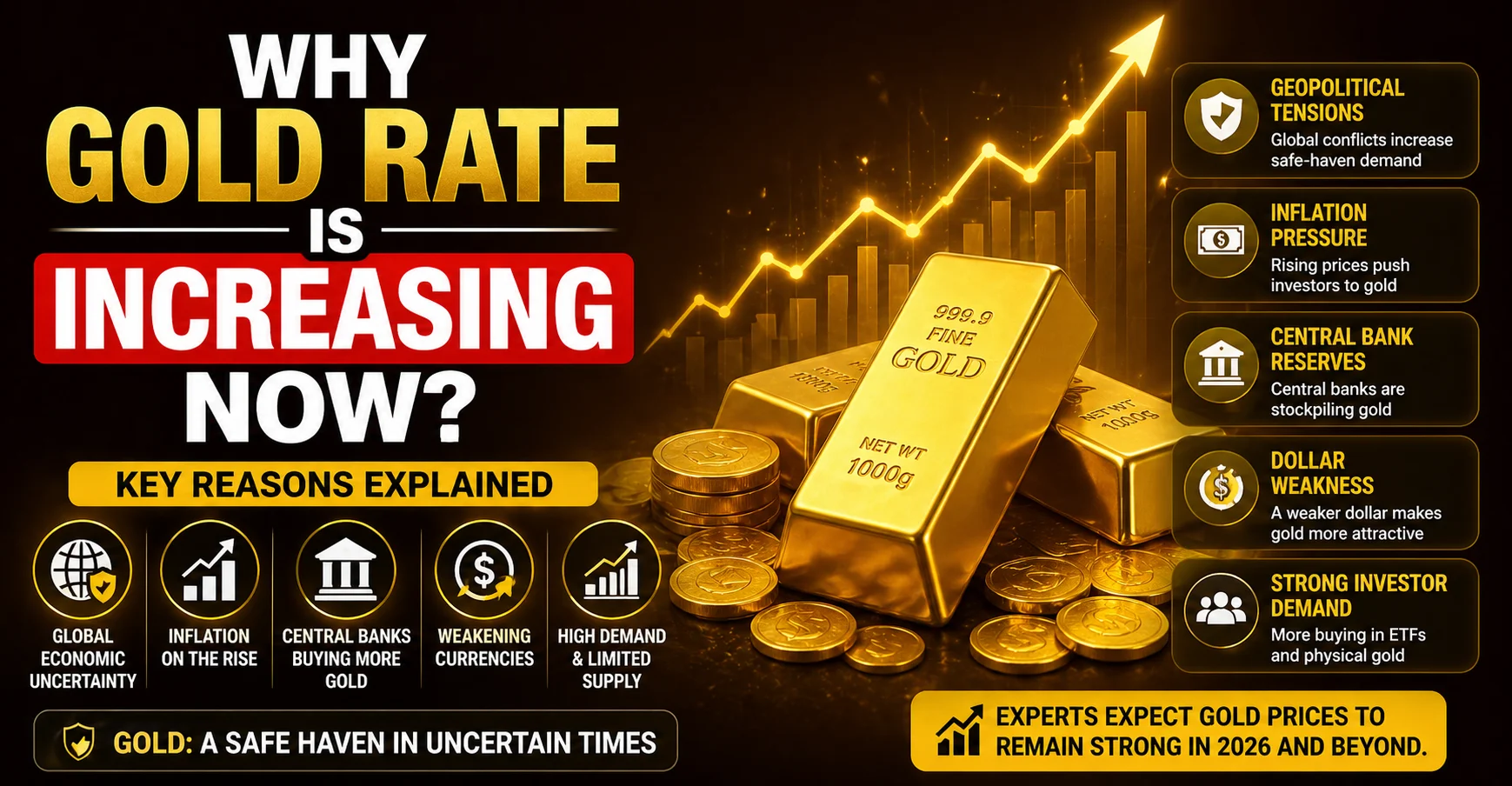
1. Global Economic Uncertainty Is Driving Safe-Haven Demand
The most fundamental reason gold rises is fear. When investors lose confidence in stocks, bonds, currencies, or the broader economy, they move money into gold. Gold has served as a store of value for thousands of years and that perception does not change during market volatility — it strengthens.
During periods of economic uncertainty, investors reduce exposure to volatile assets and move capital into gold. Continued global friction in 2026 remains a strong reason why the gold price is going up. Trade disputes, geopolitical tensions, recession concerns, and unpredictable policy decisions in major economies have collectively created a climate where gold’s safe-haven status is being actively relied upon by millions of investors worldwide simultaneously.
2. Central Banks Are Buying Gold at Record Levels
This is one of the most powerful and least discussed reasons for the current gold price surge.
Central banks accumulate gold to diversify their holdings away from traditional currencies. These large-scale institutional purchases create significant demand in the global gold market, supporting higher prices. The People’s Bank of China has kept on adding reserves consecutively for 14 months as of January 2026, with bullion held rising by 30,000 troy ounces in December 2025. The Reserve Bank of India has also kept on augmenting its gold reserves, with RBI gold holdings standing at approximately $117.45 billion.
Central bank and investor demand for gold is set to remain strong, averaging 585 tonnes a quarter in 2026. When the world’s largest institutions are buying gold in this volume, it fundamentally shifts the demand-supply balance and pushes prices structurally higher.
3. The US Dollar Is Weakening
Gold is priced globally in US dollars. When the dollar weakens, gold becomes cheaper for international buyers — which increases demand — which pushes prices higher. It is a direct relationship that plays out every time the dollar loses strength.
Trade concerns and reduced demand for the US dollar combined with increased central bank buying to create ideal conditions for the historic gold price upswing seen through 2025 and continuing into 2026. The gold price often moves in the opposite direction to the US dollar. When the dollar weakens, gold becomes more attractive to international investors. In addition, more and more countries and investors are opting for currency diversification, with gold playing an important role as a neutral and globally accepted store of value.
4. US Tariffs and Global Trade Tensions
The imposition of tariffs has increased trade tensions between the USA and India and emphasised the relevance of gold as a safe-haven investment in times of economic crisis. Every time trade war fears escalate — new tariffs, retaliatory measures, supply chain disruption — global investors respond by increasing gold exposure. In 2026, with ongoing tariff tensions between major economies, this effect has been a consistent and significant driver of demand.
5. Falling Interest Rates Make Gold More Attractive
Gold pays no interest or dividend. When interest rates are high, investors prefer bonds and savings instruments that generate income. When rates fall, gold becomes comparatively more attractive because the cost of holding it — the lost interest — shrinks.
Because gold generates no interest, it benefits in an environment of low or falling interest rates, which increases the demand for gold. With the US Federal Reserve and other major central banks either cutting rates or signalling rate cuts in 2026, the appeal of gold as a holding has increased significantly.
6. Rupee Depreciation Adds a Domestic Premium in India
Even when international gold prices stabilise, Indian gold rates can continue rising due to currency movement. Since India imports the vast majority of its gold and those imports are priced in US dollars, any weakening of the Indian rupee against the dollar directly increases the domestic rupee cost of gold.
India imports most of its gold, which means rupee depreciation immediately increases domestic prices. Even if international prices stabilise, currency impact alone can cause a gold rate change locally. This explains why the gold rate is increasing even during periods of moderate global price movement.
7. Import Duties and Domestic Policy Factors
Import duties, customs charges, and logistics expenses add significant premiums to the base gold price. In early 2026, expectations of possible changes in import duties ahead of the Union Budget pushed local gold premiums to multi-year highs, directly impacting retail prices across India.
These domestic policy factors sit on top of already elevated international prices, amplifying the rate increase that Indian consumers and investors experience at the retail level.
8. Growing Retail and ETF Investor Demand
It is not only governments and institutions buying gold. Retail investors globally are increasing their gold exposure through physical purchases, gold ETFs, Sovereign Gold Bonds, and digital gold platforms.
Gold’s share of total global financial assets has increased since 2010, rising to about 2.8% in Q3 2025. With increased financial uncertainty and concerns about the economy, retail investors are becoming more interested in physical gold such as bars, bullions, and coins. In India, this trend is amplified by deep cultural affinity for gold as both an asset and a symbol of security — making demand resilient even at elevated price levels.
What Do Experts Predict for Gold Prices Going Forward?
The expert consensus is that the structural drivers behind gold’s rise are not exhausted.
J.P. Morgan Global Research is forecasting gold prices to average $5,055 per ounce by the final quarter of 2026, rising toward $5,400 per ounce by the end of 2027.
Morgan Stanley Research expects the rally to continue, noting that gold surpassed the share of US Treasuries in central bank reserves for the first time since 1996 — a powerful signal of confidence in the metal’s long-term value.
Analysts at Goldman Sachs forecast that gold could rise further by the middle of 2026 if inflation remains elevated and real interest rates stay low, sustaining safe-haven demand.
What This Means for You as an Indian Buyer or Investor
If you are planning to buy gold jewellery — for a wedding, festival, or personal purchase — current prices are significantly elevated compared to historical norms. Waiting for a major price correction may not be the right strategy given the structural drivers in play, but short-term volatility is always possible.
If you are considering gold as an investment — through ETFs, Sovereign Gold Bonds, or digital gold — the long-term outlook from multiple major financial institutions is positive, though no investment is risk-free and gold can experience sharp short-term corrections.
On 25 April 2026, demand in India remains steady due to cultural buying patterns and investment diversification, suggesting that Indian consumers are continuing to buy despite elevated prices — a pattern consistent with India’s deeply rooted relationship with gold through every economic cycle.
Frequently Asked Questions: Why Gold Rate Is Increasing
Q: Why is gold rate increasing so fast in India in 2026?
A: Gold rates are increasing in India in 2026 due to a combination of global safe-haven demand, record central bank purchases by countries including China and India, US dollar weakness, trade tensions and tariffs, falling global interest rates, and domestic factors including rupee depreciation and import duty expectations.
Q: Will gold rate continue to increase in 2026?
A: Leading financial institutions including J.P. Morgan, Goldman Sachs, and Morgan Stanley all forecast continued elevation in gold prices through 2026, driven by central bank buying, investor demand, and persistent geopolitical uncertainty. Short-term corrections are always possible but the long-term trend is assessed as upward.
Q: Why does the US dollar affect gold prices in India?
A: Gold is traded globally in US dollars. When the dollar weakens, international gold prices rise. Since India imports most of its gold and pays for it in dollars, a weaker dollar combined with a weaker rupee creates a double effect — international prices rise and the rupee cost of those imports rises simultaneously, pushing Indian retail gold rates higher.
Q: Is buying gold a good idea when gold rates are increasing?
A: This depends on your purpose. For jewellery purchases tied to specific occasions, timing flexibility is limited. For investment purposes, gold at elevated prices still offers portfolio diversification and inflation protection, but investors should consider spreading purchases over time rather than investing a large lump sum at peak prices. Sovereign Gold Bonds and gold ETFs allow flexible, lower-cost gold investment without making charges.
Q: How does central bank gold buying affect Indian gold prices?
A: When central banks globally buy large volumes of gold, it reduces global supply available to other buyers and increases structural demand — both of which support higher prices. These institutional purchases, particularly by China and India’s RBI, have been a consistent and significant price driver through 2025 and into 2026.