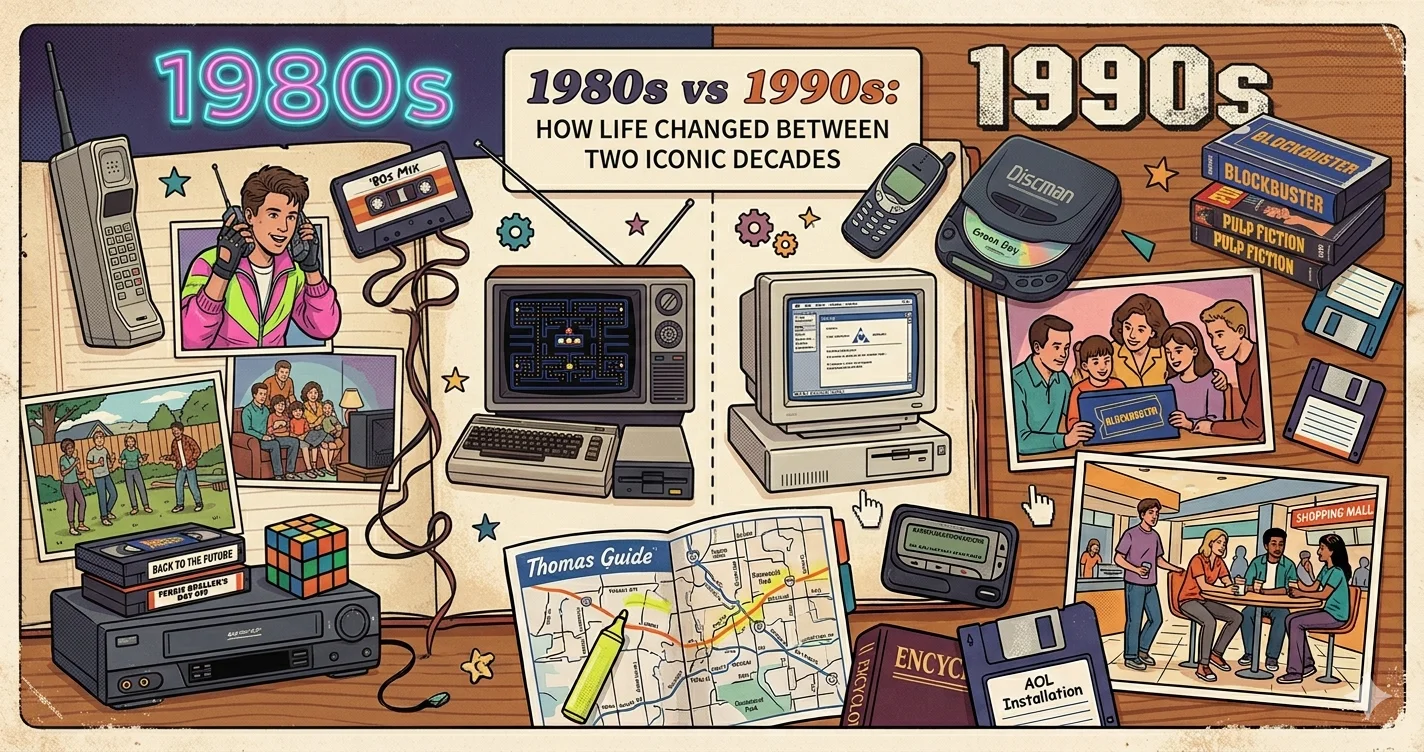
The 1980s and 1990s are often remembered as two of the most influential decades of the modern era. While both decades existed before smartphones and social media, they were surprisingly different in terms of technology, entertainment, fashion, communication, and everyday life.
The 1980s were characterized by bold fashion, economic growth, and the rise of personal computers. The 1990s, on the other hand, witnessed the early internet revolution, changing music trends, and the beginning of the digital age.
Let’s explore the major differences between life in the 1980s and the 1990s.
1. Technology: Analog vs Early Digital
Life in the 1980s
Technology was still largely analog.
People relied on:
- Landline telephones
- Typewriters
- VHS tapes
- Cassette players
- Walkmans
Personal computers existed but were mostly used by businesses, schools, and technology enthusiasts.
Internet access was virtually nonexistent for ordinary households.
Life in the 1990s
The 1990s introduced consumers to the digital revolution.
Popular technologies included:
- Personal computers
- CD players
- Video game consoles
- Mobile phones (for some users)
- Dial-up internet
By the late 1990s, many families were beginning to explore the World Wide Web.
Key Difference
The 1980s were primarily analog, while the 1990s laid the foundation for today’s digital world.
2. Communication
1980s
Communication options were limited.
People communicated through:
- Landline phones
- Letters
- Fax machines
- Face-to-face meetings
Long-distance calls were expensive, so many families used letters to stay in touch.
1990s
Communication became faster.
New developments included:
- Early mobile phones
- Pager devices
- Instant messaging (late 1990s)
However, most communication still occurred through landlines.
Key Difference
The 1990s introduced electronic communication, while the 1980s relied almost entirely on traditional methods.
3. Music Trends
1980s
The 1980s music scene was dominated by:
- Pop music
- Synth-pop
- Rock bands
- New Wave music
Music videos became extremely popular thanks to channels like MTV.
Artists focused heavily on visual presentation and performance.
1990s
Music styles became more diverse.
Popular genres included:
- Grunge
- Hip-hop
- Alternative rock
- R&B
- Pop
The decade introduced a more casual and authentic musical style compared to the glamorous image of the 1980s.
Key Difference
1980s music was flashy and energetic, while 1990s music emphasized realism and emotional expression.
4. Fashion
1980s Fashion
Fashion in the 1980s was bold and colorful.
Popular trends included:
- Shoulder pads
- Neon colors
- Leather jackets
- Big hairstyles
- Leg warmers
People often wore eye-catching outfits designed to stand out.
1990s Fashion
Fashion became more relaxed.
Popular styles included:
- Baggy jeans
- Flannel shirts
- Denim jackets
- Sneakers
- Simple T-shirts
Minimalism replaced much of the extravagance of the previous decade.
Key Difference
The 1980s celebrated bold fashion, while the 1990s embraced comfort and simplicity.
5. Television and Entertainment
1980s
Television was one of the primary sources of entertainment.
Families watched:
- Sitcoms
- Game shows
- Cartoons
- Music channels
Video rental stores began gaining popularity.
1990s
Entertainment options expanded significantly.
People enjoyed:
- Larger cable TV networks
- Popular sitcoms
- Video games
- Movie rentals
Gaming became much more mainstream during the 1990s.
Key Difference
The 1990s offered greater entertainment variety and more advanced gaming experiences.
6. Internet and Information Access
1980s
People gathered information through:
- Newspapers
- Libraries
- Encyclopedias
- Television news
Research often required physical books and visits to libraries.
1990s
The internet started changing information access.
People could:
- Browse websites
- Send emails
- Search for information online
However, traditional sources still remained important.
Key Difference
The internet was virtually absent in the 1980s but began transforming society during the 1990s.
7. Gaming Culture
1980s
Gaming was largely centered around arcades.
Popular systems included:
- Atari
- Nintendo Entertainment System (NES)
Children often visited gaming centers to play.
1990s
Home gaming exploded in popularity.
Popular consoles included:
- PlayStation
- Nintendo 64
- Sega Genesis
Gaming became a major part of youth culture.
Key Difference
The 1980s focused on arcade gaming, while the 1990s shifted gaming into people’s homes.
8. Shopping Experience
1980s
Shopping was entirely offline.
People bought products from:
- Department stores
- Local markets
- Shopping centers
Cash transactions were common.
1990s
Shopping remained physical, but technology slowly entered retail.
Credit card usage increased, and early e-commerce websites began appearing near the end of the decade.
Key Difference
The 1990s marked the beginning of online commerce, though traditional shopping still dominated.
9. Workplace Environment
1980s
Most offices relied heavily on:
- Paper documents
- Filing cabinets
- Typewriters
Computers were not yet standard workplace equipment.
1990s
Computers became increasingly common.
Employees started using:
- Word processing software
- Digital spreadsheets
Office work became more efficient.
Key Difference
The 1990s accelerated workplace digitization.
10. Lifestyle and Social Life
1980s
Life was highly community-focused.
People spent more time:
- Visiting neighbors
- Participating in local events
- Engaging in outdoor activities
Technology played a relatively small role.
1990s
Social life remained personal, but digital tools began emerging.
People still gathered in person, but computers and the internet slowly became part of daily life.
Key Difference
The 1980s were entirely offline, while the 1990s represented the transition into the digital age.
Quick Comparison Table
| Category | 1980s | 1990s |
|---|---|---|
| Technology | Analog devices | Early digital technology |
| Internet | Virtually absent | Dial-up internet introduced |
| Communication | Letters and landlines | Email and mobile phones emerge |
| Fashion | Bright, bold, flashy | Casual and minimalist |
| Music | Synth-pop and rock | Grunge, hip-hop, alternative |
| Gaming | Arcades and NES | PlayStation and home gaming |
| Shopping | Physical stores only | Early online shopping begins |
| Workplaces | Paper-based systems | Computer-based workflows |
| Entertainment | TV and VHS | Cable TV and advanced gaming |
| Lifestyle | Traditional and local | Transition toward digital living |
Conclusion
The 1980s and 1990s may seem similar compared to today’s highly connected world, but they represent two distinct periods in modern history.
The 1980s were the final great decade of an entirely analog lifestyle, filled with bold fashion, physical media, and traditional communication methods. The 1990s introduced personal computers, the internet, mobile phones, and digital entertainment, setting the stage for the technological transformation of the 21st century.
Together, these decades shaped the modern world and continue to inspire nostalgia among people who experienced them firsthand.
FAQs
Which decade had better technology, the 1980s or 1990s?
The 1990s had more advanced technology, including personal computers, mobile phones, and internet access.
Was the internet available in the 1980s?
The internet existed in limited forms, but it was not accessible to most households. Widespread public internet use began in the 1990s.
How was fashion different between the 1980s and 1990s?
The 1980s featured bright colors and bold styles, while the 1990s favored casual, comfortable clothing and minimalist fashion.
Were mobile phones common in the 1990s?
Mobile phones became more available during the 1990s, but they were not as common or affordable as they are today.
Why are both decades so popular today?
People remember the 1980s and 1990s for their unique culture, music, fashion, and the simpler lifestyle that existed before social media and smartphones.
Why Do We Feel Lost in Our 20s? (Complete Guide for Clarity & Direction)