Buying a used car can be one of the smartest financial decisions you make. A well-maintained second-hand vehicle can offer excellent value for money, lower depreciation, and reduced insurance costs compared to a brand-new car. However, purchasing a used car also comes with certain risks. Hidden mechanical issues, incomplete paperwork, accident history, or odometer tampering can turn what seems like a great deal into an expensive mistake.
Whether you’re buying your first car or upgrading to a newer model, conducting a thorough inspection before making a purchase is essential. A little research and careful evaluation can save you thousands of rupees in repair costs and future headaches.
This comprehensive guide covers everything you need to check before buying a used car, helping you make an informed and confident decision.
Why Buy a Used Car?
Before discussing the inspection checklist, it’s worth understanding why many buyers choose used cars over new ones.
Lower Purchase Cost
The biggest advantage of buying a used car is affordability. You can often get a higher-end model with better features at the same budget as a new entry-level vehicle.
Reduced Depreciation
New cars lose a significant portion of their value within the first few years. Used cars have already undergone the steepest depreciation, making them a better value proposition.
Lower Insurance Premiums
Insurance costs are generally lower for used vehicles because their market value is less than new cars.
More Options Within Budget
Buying used allows you to consider premium brands and feature-rich variants that may otherwise be out of reach.
Research Before You Start Shopping
One of the most common mistakes buyers make is purchasing a car based solely on appearance or price.
Before meeting a seller:
- Determine your budget
- Research the car model
- Compare market prices
- Read owner reviews
- Check maintenance costs
- Verify fuel efficiency
Understanding the typical price range helps you identify deals that are too good to be true.
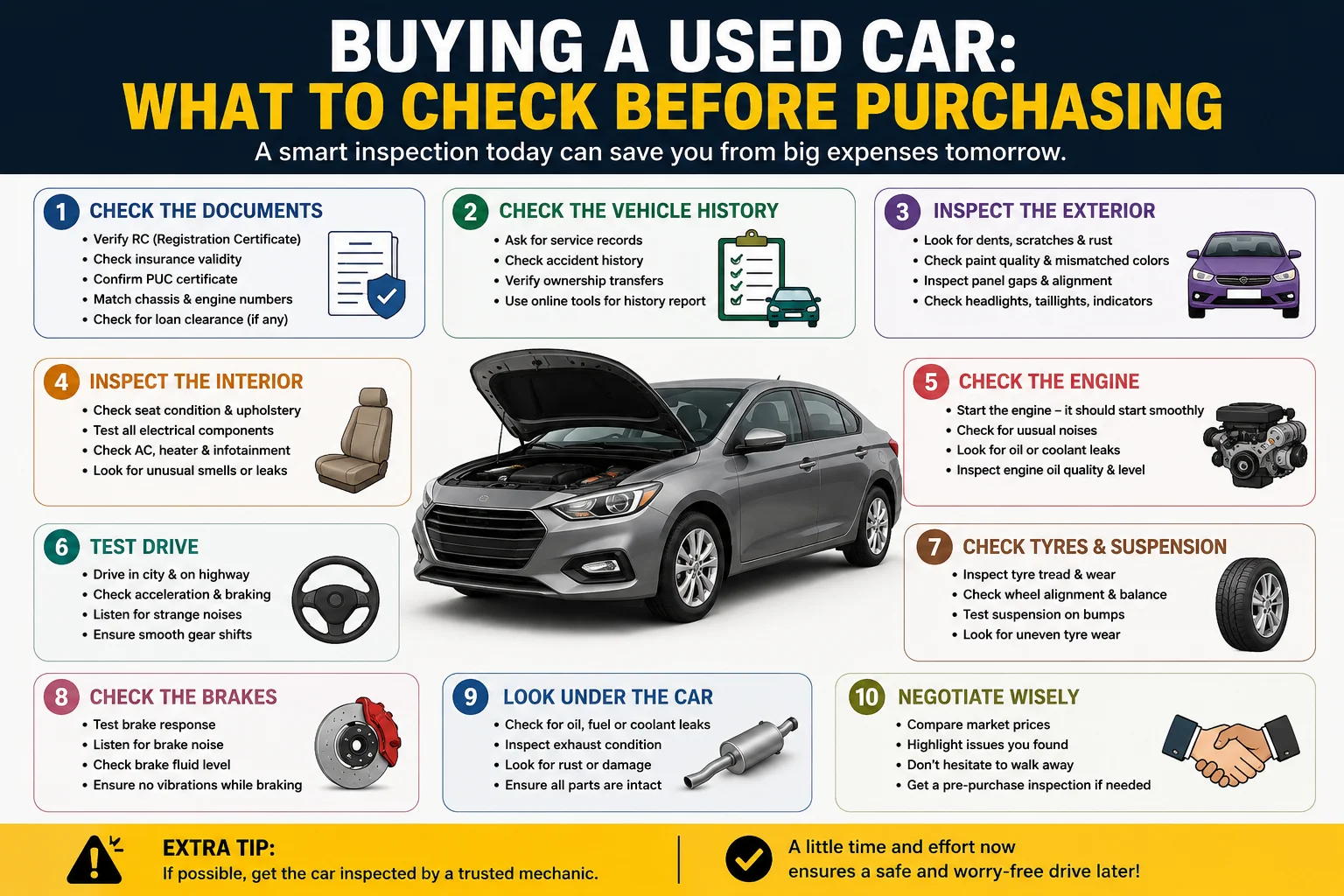
Check the Vehicle Registration Documents
Documentation verification should be your first priority.
Registration Certificate (RC)
The Registration Certificate proves ownership of the vehicle.
Verify:
- Owner’s name
- Registration number
- Chassis number
- Engine number
- Fuel type
- Manufacturing year
Ensure that all details match the actual vehicle.
Insurance Papers
Check whether the insurance policy is active.
Review:
- Policy validity
- Claim history
- Comprehensive or third-party coverage
A vehicle with multiple insurance claims may have been involved in accidents.
Pollution Under Control (PUC) Certificate
A valid PUC certificate confirms compliance with emission standards.
Road Tax Records
Verify that all applicable road taxes have been paid.
Loan Clearance Documents
If the car was financed, ensure that the loan has been completely repaid and that the hypothecation has been removed from the RC.
Verify Ownership History
Knowing how many owners the vehicle has had can provide valuable insight.
Generally:
- First-owner vehicles are preferred.
- Second-owner cars can still be good purchases.
- Multiple-owner vehicles may indicate recurring issues.
Ask why the owner is selling the car.
While genuine reasons exist, vague or inconsistent explanations may be warning signs.
Check the Vehicle Identification Numbers
Every car has unique identification numbers.
Compare:
- Chassis number
- Engine number
- Registration details
These numbers should match the documentation exactly.
Any mismatch could indicate legal or ownership issues.
Inspect the Exterior Condition
A visual inspection can reveal signs of poor maintenance or previous accidents.
Paint Quality
Walk around the car and inspect the paint carefully.
Look for:
- Different shades of paint
- Overspray marks
- Uneven surfaces
- Fresh paint patches
These may indicate accident repairs.
Body Panels
Check:
- Door alignment
- Bonnet alignment
- Boot alignment
- Panel gaps
Uneven gaps may suggest previous collision damage.
Rust and Corrosion
Inspect:
- Wheel arches
- Underbody
- Door edges
- Roof gutters
Rust can spread quickly and become expensive to repair.
Glass Inspection
Examine all windows and windshields for:
- Cracks
- Chips
- Replacements
Different manufacturing dates on glass panels may indicate accident repairs.
Check the Tires
Tires provide valuable information about a vehicle’s condition.
Inspect:
- Tread depth
- Sidewall damage
- Uneven wear patterns
Uneven wear may indicate:
- Wheel alignment issues
- Suspension problems
- Accident-related damage
Also verify whether all tires are from the same brand and age group.
Examine the Interior
The cabin can reveal how well the vehicle has been maintained.
Seat Condition
Check for:
- Excessive wear
- Tears
- Stains
- Sagging cushions
Dashboard and Controls
Test:
- Air conditioning
- Power windows
- Infotainment system
- Touchscreen
- Steering controls
- Central locking
Repairing electronic components can be costly.
Warning Lights
Turn on the ignition and check for warning lights.
Look for:
- Engine warning light
- ABS light
- Airbag light
- Battery light
Persistent warning indicators may signal underlying issues.
Inspect the Engine
The engine is the heart of the vehicle.
Engine Bay Inspection
Open the bonnet and inspect:
- Oil leaks
- Coolant leaks
- Loose wires
- Damaged hoses
A clean engine bay is good, but an excessively cleaned engine may be hiding leaks.
Engine Oil
Check the oil dipstick.
Healthy oil should:
- Have adequate level
- Appear relatively clean
- Not contain metal particles
Coolant
Verify that coolant levels are adequate and free from contamination.
Engine Noise
Start the engine and listen carefully.
Watch for:
- Knocking sounds
- Ticking noises
- Excessive vibrations
The engine should run smoothly without unusual sounds.
Check the Transmission
Transmission repairs are among the most expensive automotive fixes.
Manual Transmission
Ensure:
- Smooth gear changes
- No grinding noises
- Proper clutch engagement
Automatic Transmission
Check:
- Smooth shifts
- No hesitation
- No jerking
Delayed gear engagement can indicate transmission problems.
Evaluate the Suspension
Drive over uneven roads during the test drive.
Listen for:
- Clunking sounds
- Excessive bouncing
- Suspension squeaks
A properly functioning suspension should provide a comfortable and controlled ride.
Test the Brakes
Brakes are critical for safety.
During the test drive:
- Apply brakes firmly
- Check stopping distance
- Listen for squealing sounds
- Watch for vehicle pulling to one side
Brake issues may require immediate attention after purchase.
Inspect the Battery
Ask about the battery’s age.
Check for:
- Corrosion around terminals
- Weak starting performance
- Electrical inconsistencies
A battery nearing the end of its life may need replacement soon.
Review Service History
A complete service history is one of the strongest indicators of responsible ownership.
Look for:
- Regular servicing
- Authorized service center records
- Major repair documentation
- Replacement part records
Well-documented maintenance often reflects a well-maintained vehicle.
Check Mileage Carefully
Mileage affects both value and wear.
However, mileage alone should not determine your decision.
A higher-mileage car with proper maintenance can be a better purchase than a low-mileage car that was neglected.
Be alert for signs of odometer tampering:
- Excessively worn pedals
- Worn steering wheel
- Damaged gear knob
- Mileage inconsistent with service records
Look for Accident History
Many used cars have experienced minor accidents, but major structural damage should raise concerns.
Signs include:
- Weld marks
- Misaligned panels
- Repainted sections
- Replaced airbags
Always ask the seller directly about accident history.
Take a Thorough Test Drive
Never buy a used car without driving it.
During the test drive:
Drive in City Traffic
Evaluate:
- Steering response
- Clutch operation
- Brake performance
Drive at Highway Speeds
Check:
- Stability
- Engine performance
- Wind noise
Listen Carefully
Pay attention to:
- Engine sounds
- Suspension noises
- Vibrations
A test drive often reveals issues that visual inspections cannot.
Get a Professional Inspection
Even if you have automotive knowledge, a professional inspection is highly recommended.
A trusted mechanic can identify:
- Hidden damage
- Engine issues
- Suspension wear
- Transmission problems
- Electrical faults
The inspection cost is small compared to the expense of unexpected repairs.
Verify Market Value
Compare the asking price with:
- Similar listings
- Dealer prices
- Online valuation tools
Factors affecting value include:
- Age
- Mileage
- Condition
- Ownership history
- Service records
Avoid overpaying based solely on appearance.
Red Flags to Watch Out For
Avoid vehicles with:
- Missing documents
- Unclear ownership
- Accident concealment
- Excessive rust
- Flood damage
- Odometer tampering
- Incomplete service history
- Reluctant sellers
If something feels suspicious, walk away and explore other options.
Final Thoughts
Buying a used car can be a rewarding and cost-effective decision when approached carefully. The key is conducting a thorough inspection, verifying documentation, reviewing service history, and taking the vehicle for a detailed test drive.
Never rush into a purchase because of a seemingly attractive price. A little patience and due diligence can help you find a reliable used car that offers years of dependable service. By following the checks outlined in this guide, you’ll significantly reduce the risk of unexpected repairs and make a purchase you can feel confident about.
Frequently Asked Questions (FAQs)
1. What is the most important thing to check when buying a used car?
Documentation, service history, engine condition, accident history, and a thorough test drive are the most important factors.
2. Is it safe to buy a used car from an individual seller?
Yes, provided you verify all documents, inspect the vehicle carefully, and preferably obtain a professional inspection.
3. How many kilometers is too much for a used car?
There is no fixed number. Maintenance history matters more than mileage alone.
4. Should I buy a car without service records?
It is generally better to avoid vehicles with missing maintenance records because their condition is harder to verify.
5. Can I negotiate the price of a used car?
Yes. Use inspection findings, market comparisons, and maintenance requirements to negotiate fairly.
6. Is a professional inspection necessary?
Absolutely. A professional mechanic can identify hidden issues that are difficult for most buyers to detect.
7. How do I know if a used car has been in an accident?
Look for uneven paint, panel gaps, replaced parts, weld marks, and insurance claim history.
8. What documents should I receive after purchase?
You should receive the RC, insurance papers, PUC certificate, service records, loan clearance documents (if applicable), and ownership transfer forms.