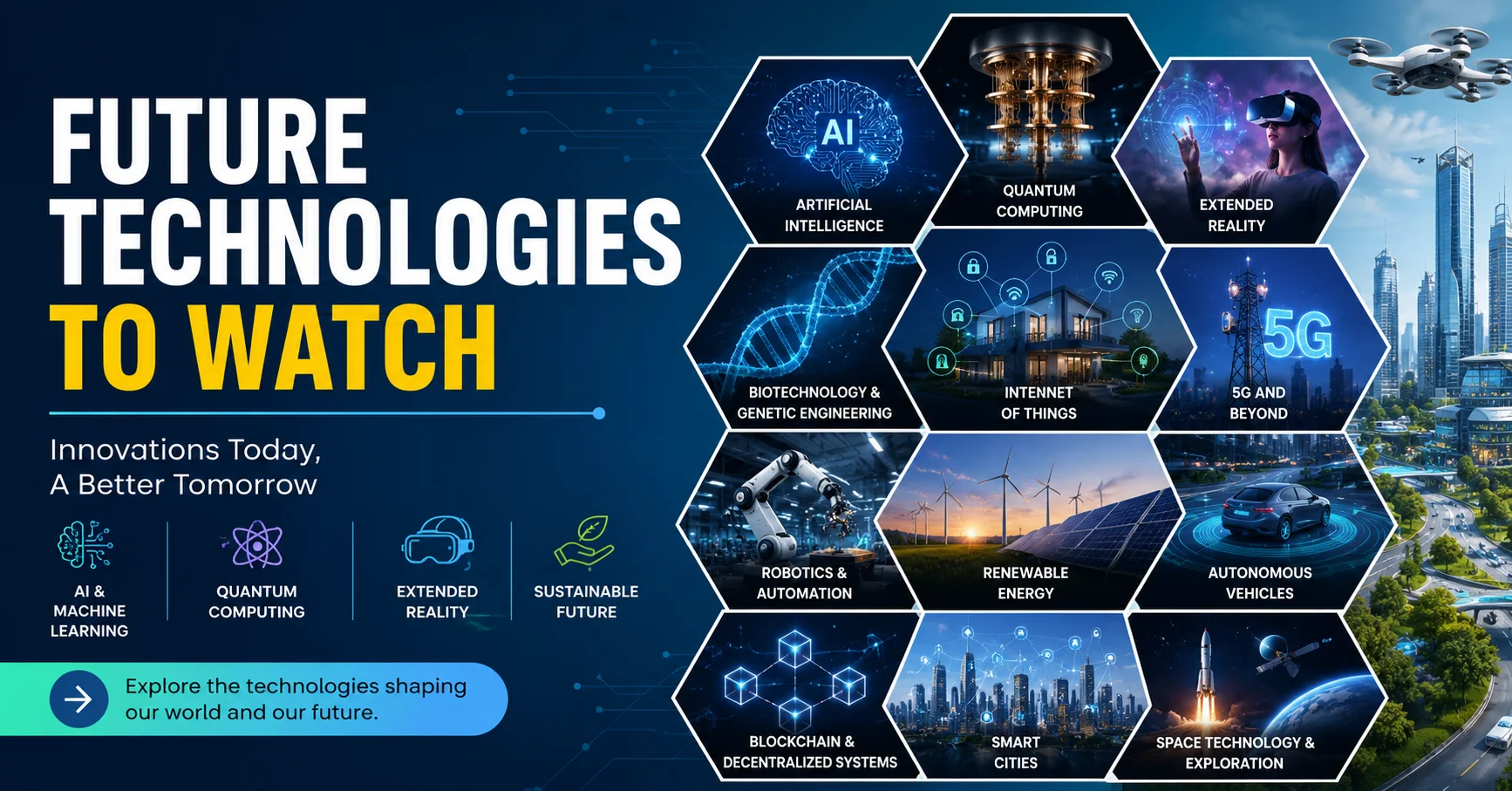
Technology is evolving at an unprecedented pace, transforming the way we live, work, and interact with the world. From artificial intelligence to space exploration, emerging innovations are creating opportunities that seemed impossible just a decade ago. Understanding these future technologies can help individuals and businesses prepare for the next wave of digital transformation.
In this article, we explore the most promising future technologies to watch and how they are expected to impact industries and everyday life.
1. Artificial Intelligence (AI) and Machine Learning
Artificial Intelligence continues to be one of the most influential technologies of the future. AI systems are becoming smarter, faster, and more capable of handling complex tasks.
Key Applications:
- Virtual assistants and chatbots
- Predictive analytics
- Personalized healthcare
- Autonomous vehicles
- Fraud detection in finance
Generative AI tools are already revolutionizing content creation, software development, and customer support. As AI models become more advanced, businesses will increasingly rely on them to improve efficiency and decision-making.
2. Quantum Computing
Quantum computing has the potential to solve problems that traditional computers cannot handle efficiently. Unlike classical computers that use bits, quantum computers use qubits, allowing them to perform multiple calculations simultaneously.
Potential Benefits:
- Faster drug discovery
- Improved cybersecurity
- Advanced climate modeling
- Complex financial simulations
- Optimization of supply chains
Although still in its early stages, quantum computing is expected to become a game-changing technology in the coming decades.
3. Extended Reality (XR)
Extended Reality combines Virtual Reality (VR), Augmented Reality (AR), and Mixed Reality (MR) to create immersive digital experiences.
Future Uses:
- Virtual classrooms
- Remote collaboration
- Gaming and entertainment
- Medical training
- Real estate visualization
As hardware becomes more affordable and powerful, XR technologies will become a regular part of education, healthcare, and workplace environments.
4. Biotechnology and Genetic Engineering
Biotechnology is advancing rapidly, offering groundbreaking solutions for healthcare, agriculture, and environmental sustainability.
Emerging Innovations:
- Gene editing using CRISPR
- Personalized medicine
- Lab-grown meat
- Disease-resistant crops
- Advanced diagnostics
Scientists are working on treatments that target diseases at the genetic level, potentially curing conditions that were previously considered untreatable.
5. Internet of Things (IoT)
The Internet of Things connects everyday devices to the internet, enabling them to collect and exchange data.
Examples:
- Smart homes
- Connected vehicles
- Wearable health devices
- Smart factories
- Agricultural monitoring systems
With billions of connected devices expected in the future, IoT will play a critical role in improving efficiency, convenience, and resource management.
6. 5G and Beyond
The rollout of 5G networks is enabling faster internet speeds, lower latency, and improved connectivity.
Impact of 5G:
- Enhanced mobile experiences
- Real-time remote surgeries
- Smart city infrastructure
- Autonomous transportation
- Advanced IoT applications
Researchers are already exploring 6G technology, which could provide even greater speeds and support highly sophisticated digital ecosystems.
7. Robotics and Automation
Modern robots are becoming increasingly intelligent and capable of performing complex tasks.
Industries Benefiting:
- Manufacturing
- Healthcare
- Logistics
- Agriculture
- Retail
Collaborative robots, also known as cobots, are designed to work alongside humans rather than replace them. This technology helps improve productivity while reducing workplace risks.
8. Renewable Energy Technologies
The future of energy is becoming cleaner and more sustainable. Innovations in renewable energy technologies are helping reduce dependence on fossil fuels.
Key Developments:
- Advanced solar panels
- Offshore wind farms
- Green hydrogen
- Energy storage systems
- Smart energy grids
As governments and organizations focus on sustainability, renewable energy technologies will play a major role in addressing climate change.
9. Autonomous Vehicles
Self-driving technology is progressing rapidly, with major companies investing heavily in autonomous transportation systems.
Potential Benefits:
- Reduced traffic accidents
- Improved mobility for elderly and disabled individuals
- Lower transportation costs
- Increased fuel efficiency
- Better traffic management
While fully autonomous vehicles are still under development, semi-autonomous features are already becoming common in modern cars.
10. Blockchain and Decentralized Systems
Blockchain technology extends far beyond cryptocurrencies. Its ability to provide secure, transparent, and tamper-proof records makes it valuable across many industries.
Applications:
- Supply chain tracking
- Digital identity verification
- Smart contracts
- Healthcare records
- Secure voting systems
As trust and transparency become increasingly important, blockchain adoption is expected to continue growing.
11. Smart Cities
Future cities will leverage technology to improve infrastructure, sustainability, and quality of life.
Smart City Features:
- Intelligent traffic management
- Smart lighting systems
- Waste management optimization
- Real-time environmental monitoring
- Energy-efficient buildings
By integrating data-driven technologies, smart cities aim to create safer, cleaner, and more efficient urban environments.
12. Space Technology and Exploration
Space innovation is accelerating thanks to advances in reusable rockets, satellite technology, and private-sector investment.
Future Possibilities:
- Commercial space tourism
- Lunar exploration
- Mars missions
- Satellite internet services
- Space-based manufacturing
The growing space industry could unlock new economic opportunities while expanding humanity’s understanding of the universe.
Why Future Technologies Matter
Emerging technologies are not just transforming industries—they are reshaping society itself. Businesses that embrace innovation can gain a competitive advantage, while individuals who stay informed can better prepare for future career opportunities.
Many of the jobs that will exist in the next decade have not yet been created. Skills related to AI, data science, cybersecurity, cloud computing, and digital transformation are becoming increasingly valuable as technology continues to evolve.
Conclusion
The future promises remarkable technological advancements that will influence every aspect of our lives. Artificial intelligence, quantum computing, biotechnology, robotics, renewable energy, and smart cities are just a few of the innovations poised to shape the next generation.
Staying informed about these future technologies can help individuals, businesses, and governments adapt to a rapidly changing world. While predicting the future is never easy, one thing is certain: technology will continue to drive progress and create opportunities that redefine what is possible.
FAQs
What is the most important future technology?
Artificial Intelligence is widely considered one of the most important future technologies due to its broad applications across industries, including healthcare, finance, education, and transportation.
How will quantum computing impact society?
Quantum computing could revolutionize scientific research, drug discovery, financial modeling, and cybersecurity by solving complex problems much faster than traditional computers.
What are smart cities?
Smart cities use connected technologies, sensors, and data analytics to improve urban services, reduce energy consumption, and enhance residents’ quality of life.
Will robots replace human jobs?
While automation may replace certain repetitive tasks, it is also expected to create new job opportunities that require human creativity, problem-solving, and technical expertise.
Why should businesses monitor emerging technologies?
Businesses that adopt emerging technologies early can improve efficiency, enhance customer experiences, and gain a competitive advantage in the market.