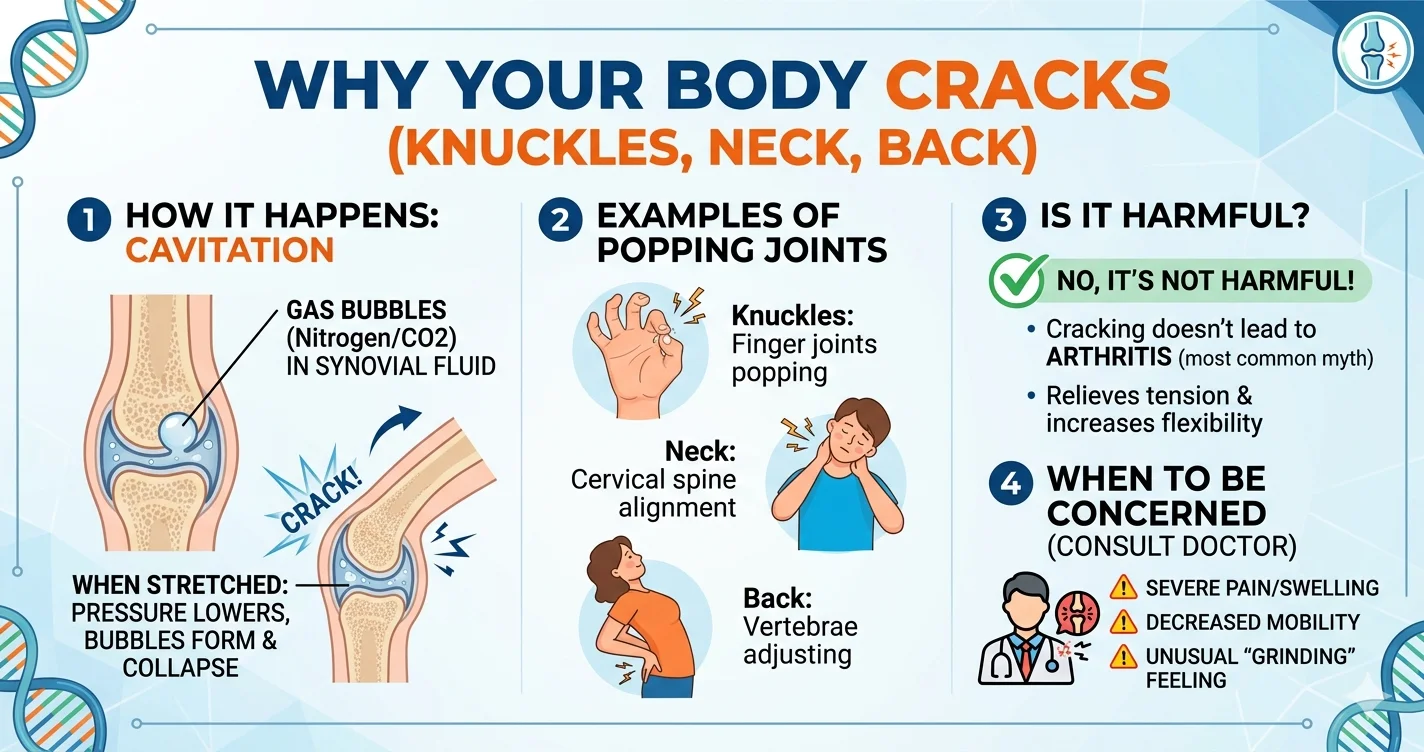
Many people notice their body “cracking” or “popping” during daily movements—especially in the knuckles, neck, shoulders, and back. For some, it feels satisfying or relieving. For others, it causes concern: Is this normal? Am I damaging my joints?
The good news is that in most cases, body cracking is harmless. But understanding why it happens helps you know when it’s safe—and when it might be a warning sign.
What Causes the Cracking Sound in Your Body?
The cracking sound mainly comes from joints, where two bones meet. These joints contain a lubricating fluid called synovial fluid, which helps your bones move smoothly.
Inside this fluid are dissolved gases like:
- Oxygen
- Nitrogen
- Carbon dioxide
When you stretch or move a joint, pressure changes inside the joint space. This causes gases to rapidly form bubbles and then collapse or burst.
This process is called:
🫧 Cavitation (Gas Bubble Formation)
P_{joint} \downarrow \Rightarrow gas\ bubbles\ form\ and\ collapse
That “pop” or “crack” sound you hear is the release or collapse of these gas bubbles.
Why Knuckles Crack
Knuckle cracking is the most common form of joint popping.
What happens:
- Stretching your fingers increases joint space
- Pressure drops inside the joint
- Gas bubbles form and collapse
- You hear a popping sound
Important fact:
After cracking your knuckles, you usually cannot do it again immediately because the gases need time (about 15–30 minutes) to dissolve back into the fluid.
Why Your Neck Cracks
Neck cracking often happens during:
- Turning your head
- Stretching after sitting long hours
- Poor posture correction movements
Possible causes:
- Gas bubble release (harmless)
- Tendons or ligaments moving over bones
- Minor joint stiffness releasing
⚠️ However, frequent or forceful neck cracking should be avoided, especially if it causes pain.
Why Your Back Cracks
Back cracking is very common when:
- Stretching after sitting or sleeping
- Twisting your torso
- Doing yoga or exercise
Reasons:
- Facet joints in the spine adjust position
- Gas bubbles release
- Tight muscles and ligaments shift
Many people feel relief after back cracking because it temporarily reduces pressure in the joints.
Is Body Cracking Harmful?
👍 In most cases: NO
Research shows that:
- Knuckle cracking does NOT cause arthritis
- Occasional joint popping is normal
- It does not “wear out” your joints
⚠️ But it can be harmful if:
- It is forced repeatedly
- It causes pain or swelling
- It is associated with injury or trauma
- You feel numbness or weakness
When You Should Be Concerned
You should consult a doctor if cracking is accompanied by:
- Pain during movement
- Swelling or redness
- Joint instability
- Frequent stiffness
- Tingling or nerve pain (especially in neck/back)
These may indicate underlying issues like:
- Arthritis
- Ligament injury
- Disc problems in the spine
Is It Okay to Crack Your Joints on Purpose?
Occasional cracking is fine, but habitual knuckle or neck cracking can:
- Irritate surrounding tissues
- Lead to dependency (habit formation)
- Cause mild discomfort over time
Instead of forcing cracks, try:
- Stretching regularly
- Improving posture
- Staying hydrated
- Light exercise or yoga
How to Reduce Excessive Cracking
If your body cracks too often, it may be due to stiffness or inactivity.
Try these:
1. Stay Active
Walking and stretching keep joints flexible.
2. Improve Posture
Avoid long hours of slouching.
3. Hydration
Synovial fluid works better when you’re well-hydrated.
4. Strength Training
Stronger muscles support joints better.
Interesting Fact
Some people feel “relief” after cracking joints because it:
- Temporarily increases joint mobility
- Stimulates nerve endings
- Reduces pressure sensation
But scientifically, the “relief” is neurological, not because the joint was “fixed.”
Final Thoughts
Body cracking is usually a normal and harmless phenomenon caused by gas bubbles, joint movement, or ligament shifts. Knuckles, neck, and back cracks are common in people of all ages.
However, if cracking comes with pain or discomfort, it’s important to pay attention and seek medical advice.
In most cases, your body is simply:
Moving, adjusting, and releasing pressure naturally.
FAQs
1. Is cracking your knuckles bad for you?
No, studies show it does not cause arthritis or permanent damage.
2. Why does my neck crack when I move it?
It is usually due to gas bubbles or tendon movement over bones.
3. Why does my back crack so easily?
It happens due to spinal joint adjustments and muscle tightness.
4. Is frequent joint cracking normal?
Yes, but if it is painful or constant, it should be checked.
5. Can I stop my joints from cracking?
Yes—improving posture, hydration, and flexibility can reduce it.
Related: Excessive Sweaty Hands and Feet in Summer: Causes, Treatment & Easy Solutions