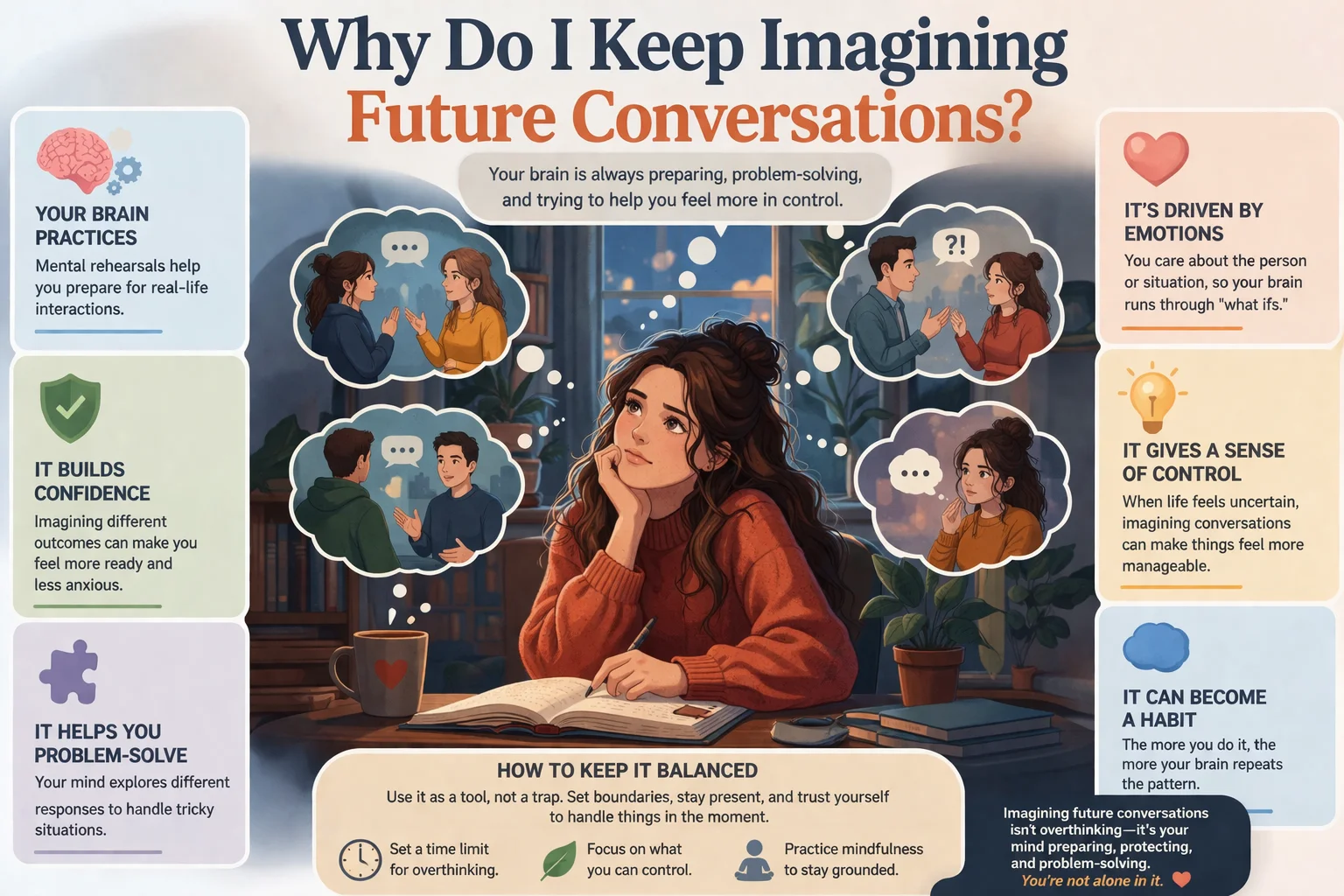
Have you ever caught yourself mentally rehearsing a conversation that hasn’t happened yet? Maybe you imagine what you’ll say in a meeting, an argument, or even a casual chat. This habit is extremely common and completely normal.
Imagining future conversations is your brain’s way of preparing, processing emotions, and trying to stay in control. But sometimes, it can become repetitive or even stressful.
Let’s understand why this happens.
1. Your Brain Is Preparing You
One of the main reasons you imagine conversations is preparation. Your brain is trying to get you ready for possible situations.
By rehearsing what you might say:
- You feel more confident
- You reduce the chances of saying the wrong thing
- You gain a sense of control
This is especially common before important events like interviews, meetings, or difficult discussions.
2. Desire for Control
Life is unpredictable, and conversations don’t always go as planned. Imagining future conversations gives you a sense of control over uncertain situations.
Even though the conversation hasn’t happened, your mind tries to predict different outcomes and prepare responses for each.
3. Social Anxiety and Overthinking
If you often worry about how others perceive you, you may replay or imagine conversations more frequently.
Your mind may:
- Try to avoid awkward moments
- Prepare “perfect” responses
- Anticipate criticism or judgment
While this can be helpful in small amounts, excessive overthinking can increase stress.
4. Emotional Processing
Sometimes, imagined conversations are a way to process emotions. If something is bothering you, your mind may create scenarios to express feelings you haven’t shared yet.
This can help you:
- Understand your emotions better
- Organize your thoughts
- Find clarity before speaking
5. The Need for Closure
If a past conversation didn’t go well, your brain may try to “fix” it by imagining how it could have gone differently.
This mental replay can create a sense of closure, even if the real situation cannot be changed.
6. Creativity and Imagination
Not all imagined conversations are about stress. Some people naturally have active imaginations.
They may:
- Create scenarios for fun
- Think through ideas or stories
- Explore different perspectives
In this case, it’s more about creativity than anxiety.
7. Habit of Overthinking
For some people, imagining conversations becomes a habit. The brain gets used to analyzing situations in detail, even when it’s not necessary.
This can turn into a loop where:
- One thought leads to another
- Scenarios keep expanding
- It becomes hard to stop
8. Fear of Conflict
If you tend to avoid conflict, you might rehearse conversations to make sure things go smoothly.
You may try to:
- Avoid saying something offensive
- Keep the conversation calm
- Predict how others might react
9. High Self-Awareness
People who are highly self-aware often think deeply about communication. They care about how they express themselves and how others interpret their words.
This awareness can lead to frequent mental rehearsals.
10. It’s Completely Normal
The most important thing to understand is that imagining future conversations is a normal mental process. Almost everyone does it to some extent.
It only becomes a problem if:
- It causes stress or anxiety
- It interferes with daily life
- You feel stuck in repetitive thinking
Why Small Discomforts Feel Bigger Than They Are (And How to Deal With It)
How to Stop Overthinking Conversations
If this habit feels overwhelming, here are some simple ways to manage it:
1. Limit “What If” Thinking
Remind yourself that not every scenario needs to be planned.
2. Stay Present
Focus on what’s happening now instead of future possibilities.
3. Write It Down
Journaling your thoughts can help clear your mind.
4. Accept Imperfection
No conversation will be perfect—and that’s okay.
5. Take Action
Sometimes, actually having the conversation is easier than imagining it.
Conclusion
Imagining future conversations is your brain’s way of preparing, protecting, and processing emotions. While it can be helpful, too much of it can lead to overthinking and stress.
By understanding why it happens and learning to manage it, you can turn this habit into a useful tool rather than a source of anxiety.
FAQs
1. Is it normal to imagine conversations in your head?
Yes, it’s a common mental habit used for preparation and emotional processing.
2. Does this mean I have anxiety?
Not necessarily. It can be normal, but frequent overthinking may be linked to anxiety.
3. Why do I imagine arguments that never happen?
Your brain is trying to prepare for possible conflicts and protect you from discomfort.
4. Can this habit be stopped?
Yes, with mindfulness and practice, you can reduce excessive overthinking.
5. Is imagining conversations a sign of intelligence?
It can be linked to self-awareness and thoughtful thinking, but it varies from person to person.